The importance of checking students’ understanding and then responding to it can not be overstated. I’ve written about this before here. I’m yet to visit a highly performing school that doesn’t already know this. I’m also yet to visit one that doesn’t use mini-whiteboards (MWBs) as the main solution to this problem. If these aren’t already a staple in your classroom I would implore you to look into them. If you have a different solution which gives you reliable and near-instant feedback on the learning of every student in your class then I would sincerely love to hear what you are doing. This post looks at 5 different strategies that can be implemented to take your MWB use to the next level across a variety of subjects.

1. Tweak the Variables
This first technique combines some ideas from responsive teaching and variation theory. Once you’ve taught whatever it is you are teaching, write a question up on the board and have students answer it on their MWBs. Make sure all students end up with the right answer on their boards then start to Tweak the Variables. Tell students not to erase the answer. Then, in front of the students alter one small part of the question and ask students the following “by changing the least possible amount on your board, make it the correct answer to this new question”.
Not only does it give students the chance to exercise their efficiency (laziness?), it can really highlight to students what changes and what stays the same depending on the input.
Examples
Maths – Expand: 2(x+4) –> 2(x-4)–>2(3x-4)–>2x(3x-4)…
Languages – Translate: I eat–> You eat –> You swim –> We swim…
It’s important to end the sequence at some point, have students clean their boards completely and start again from scratch to ensure they can still do the full process. I speak about this in more detail with Craig Barton here.
2. Be Diagnostic
The last thing you want when using MWBs is to ask a question, be presented with a bunch of wrong answers or blank boards and not know what the gap is. Before asking anything that involves multiple steps or concepts check each one individually. These will inevitably be more basic questions than what you are building up to but if it gives students a chance to be successful, that’s no bad thing. Importantly though, if you build a question from the ground up and a student gives the wrong answer you know exactly what you need to do to intervene.
Examples
English: Write down a 2 word imperative sentence–> Identify an imperative in the poem which suggests the writer feels misjudged
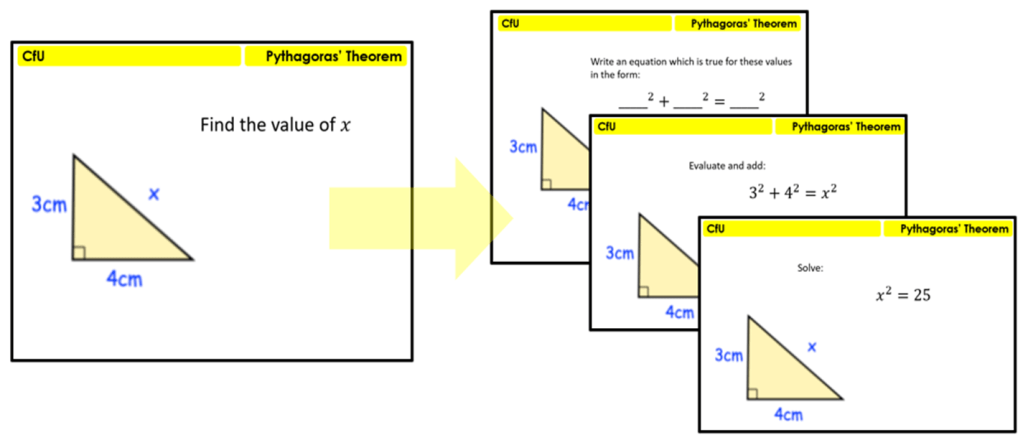
Maths: Instead of asking students to complete a Pythagoras’ Theorem question, even once you’ve modelled it, check they can do the individual steps needed.
3. Think Write Pair Rewrite Share (TWPRS)
Chances are you’ve heard of Think Pair Share and probably Think Write Pair Share. By moving this onto MWBs and including a “rewrite” phrase there is a chance for students to take the discussions they have had in their pairs and improve their answers. Whilst this is what is supposed to happen during the “pair” part, the time for students to pause and reflect and then actually make the changes on their initial answer rarely happens. Adding this phase in allows for that to happen and adds an extra layer of accountability before thoughts are shared.
Examples: Anything you would use Think (Write) Pair Share with.
4. Mimic the Task
There is an invisible gap that exists in classrooms sometimes that can completely derail a lesson. It is the gap between what the questions looks like when the class are learning and what the questions looks like when the class are practising. I have seen too many lessons thrown into confusion not because a concept hasn’t been taught well-enough but because the format of the independent task is unfamiliar.
Luckily there is a quick fix, make sure that whatever format the questions start off as match the final questions you ask students as a class on their MWBs. It’s OK (and probably essential most lessons) for questions to deviate from this and more challenge to be introduced down the line. For the students’ sake though, make it a smooth transition and mimic the task as closely as you can before students are set off to work by themselves.

5. Engage then Expand
If the plan is to get students to give a longer and wordier answer than would be appropriate for a MWB then you will probably be best off using cold-call. That’s not to say that MWBs can’t enhance this experience though. Getting students to “dip their toes” into the water of the question with, for example, a quick multiple-choice question can increase engagement. Having all students commit to the beginning of the question before getting individuals to go deeper helps increase the amount of thinking happening in the room.
Examples:
Drama – In the scene we just watched, which had the biggest impact in creating tension A/B/C/D? Boards up. Tommy – why did you choose B? Asmah – you chose C, that’s equally valid, can you explain why?…
Anything you would use cold-calling for.
END
Best of luck trying these out. Let me know how it goes and if you have any other tips to supercharge MWBs.
I’m always interested in what people make of this so please feel free to comment with thoughts, questions or incomplete musings. Follow this or my Twitter account Teach_Solutions for similar content in the future. Also, check out the rest of this site, there’s some good stuff knocking about the place.
 Teach Solutions