When reading left to right it’s relatively simple to see how something has been created and, if tasked to replicate it, that would be a simple task. Very often in maths, we do not read left to right. This can mean that, once an exemplar has been created, it can be hard to see just how to recreate the process. Numbering steps is a solution but often a tricky one to do clearly. Comic strips however, can be incredible useful.
I want to show you three examples of these quickly so we all know what we’re talking about and then discuss a few ways they can used in the classroom.
Here’s one for creating an angle bisector:

Here’s one for expanding two brackets:
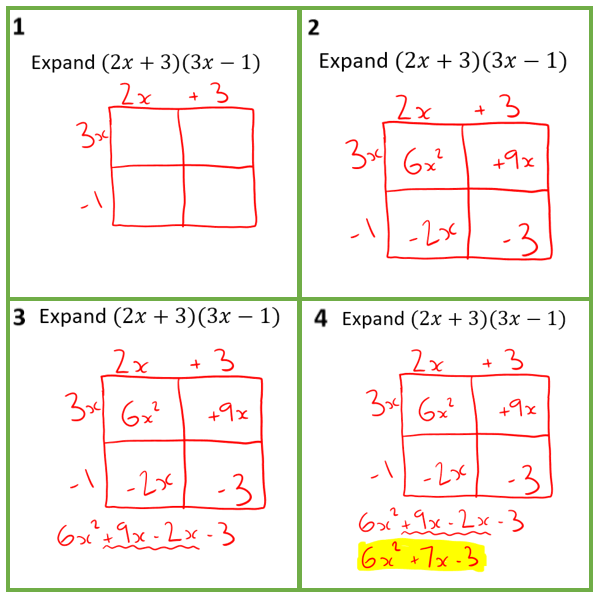
Here is an amended version of the previous with only the new content in red:

5 Ways these can be used:
1. For Reference
Simply show them to students either capturing electronically, producing live or sharing a Blue Peter “here’s one I made earlier” version with students once you’ve modelled the process. This can be shown on a board or printed for students to refer back to during the lesson. Obviously, if printed you run the risk of them becoming overly reliant on this piece of scaffolding but I will leave those choices up to you.
2. Variation Theory
Having these as a resource when looking at two different questions can be interesting. Comparing them side-by-side and looking at what is the same and what is different can help highlight underlying structures.
3. Questioning
Having students replicate the process step-by-step and then checking for understanding at each stage or asking questions that explore the “why” behind each stage can be useful.
4. Disciplinary Literacy
Exploring what the “caption” for each stage could be using academic vocabulary can help increase the levels of literacy in the room. It can also force students to use concise and accurate vocabulary.
5. Student Task
Having students create their own comic strip is a useful exercise which can help draw their attention to the key steps in the process. This might be best suited once the process has become fluent and you want them to think metacognitively about what they’ve been doing.
End
I hope you have fun exploring their use in the classroom. I think these are relatively simply to create, simply solve one question but take a screenshot or photo at each stage before building upon it. Try it out, in my experience it can be of huge benefit to students for certain topics.
I’m always interested in what people make of this so please feel free to comment with thoughts, questions or incomplete musings. Follow this or my Twitter account Teach_Solutions for similar content in the future. Also, check out the rest of this site, there’s some good stuff knocking about the place.
 Teach Solutions