A while ago I was invited onto Craig Barton’s Tips for Teachers podcast. I had to think of my top 5 tips I wanted to share with folks. The second one I went for was “leave a legacy”. This was about ensuring that when you leave a school or a position in a school that you have put systems in place that exist outside of the individual. That when you leave, your successor has something to build upon, rather than something which was only in place because it existed on your shoulders which will crumble when you leave.

A key aspect of this is for heads of department are the implementation of centralised resources. I firmly believe that any department head who does not advocate for this approach is doing a disservice to both their students and staff.
I encounter lots of schools trying to implement this (which is great!) but I sometimes see some barriers which prevent it from being as effective as it could. This post is about exploring those reasons and giving some antidotes.
This post comes with a health warning though because the reasons are incredibly dull. Vitally important. But dull as dishwater.
Centralised Planning
Quickly, before diving in, I just want to clarify what I mean by centralised planning, just in case it means something different to you. A department that uses centralised planning would have “base lessons” that are produced by members of the team and quality assured by leaders. These capture the key curriculum aims, contain pre-agreed models of working, and fit whatever lesson structure the school or department has. These then need to be personalised by every teacher before delivery to ensure it is bespoke for the unique group of individuals in that class.
Staff should still feel that they have the autonomy to personalise these resources but only to an extent. It must not jeopardise a consistent and high quality curriculum being delivered for the students over the time they study the course.
The benefits of centralised planning to the students far outweigh any negatives and, with the considerations below, most of the main criticisms laid against it (leading to lazy teaching, stripping all autonomy from teachers…) are mitigated against.
It does undeniably take some autonomy away from teachers but if what one individual wants to do is better then it should become the new normal for the department. If what that individual wants to do is worse, then it shouldn’t happen.
If this, or some version of it, is not in place then you do not end up with a department, you just have a group of individuals who happen to teach the same subject in the same building.
Reason #1
Online folder structures.
There it is. I told you it was dull. But, you’ve made it this far so let’s keep going.
The way that leaders choose to organise their subject area on whatever cloud-based systems their school uses can make or break centralised planning. Leaders need to ensure that all the base lessons are available, sure, that’s the easy bit.
They, more importantly, also need to ensure that they can access all of the adapted versions that their staff produce. Staff should not be operating in silos and saving things in some private area. The work they produce should be readily available to all. This is because:
- Improvements compound – The base lessons won’t be the best and changes/additions that staff make will in some cases improve the quality of the resource. These need saving centrally so that over time the resources go from strength to strength.
- Adaptations exist – Certain classes will contain students with additional needs (lower reading ages, colour blindness, weak numeracy…). When staff make these adaptations once and save them centrally, they will not have to be adapted from scratch if classes with similar needs need teaching in the future.
- Quality assurance – Leaders need to ensure that engagement with the resources is happening and getting into every lesson is not feasible. Having access to all resources is though. This helps with quality assurance, the sharing of good ideas and with accountability for all staff.
- Cover/Absences – If students are absent or if classes need emergency cover leaders having access to upcoming or previously taught lessons saves time.
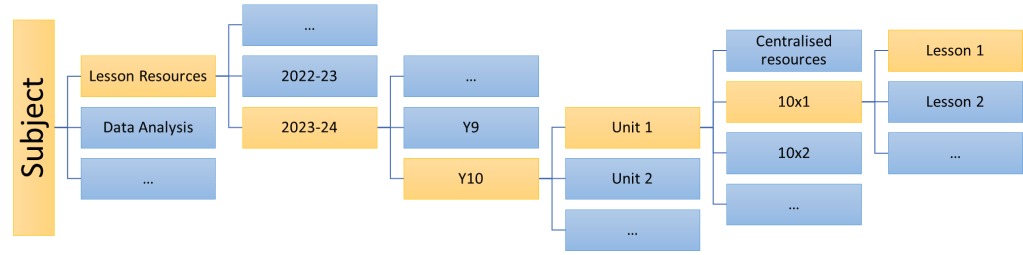
The folder structure should not be designed around staff having their own spaces within a shared area but should be designed around the learning experiences of the pupils. I.e. folders should be grouped by year group and unit, so that it is easy to navigate a child’s learning experience rather than an individual teacher’s experience.
Example structure:
Reason #2
Live modelling
When producing centralised resources it can be useful to pre-populate or pre-animate models and processes which need teaching. There is nothing wrong with this in and of itself. It can help ensure that there is a consistency in the delivery of key concepts in the department which will help students over time.
The danger comes in teachers not getting rid of these by the time it comes to them delivering the lesson. When modelling it MUST be done live. Whether that’s on a visualiser or a relatively blank board it doesn’t really matter. What is important is that the teacher knows, by the time they deliver the lesson, that they cannot “outsource” the teaching.
Reason #3
Medium-term plans
When teaching with centralised resources it can be easy to go from one lesson to the next without having a sense of any overall aim or important threads throughout the unit. Staff should engage with the unit as a whole in advance of teaching the first lesson and produce their own sequence of what their lessons will cover. This may involve merging or splitting existing resources to cater for the specific needs of their class. It should also involve a brief conversation before the teaching each unit (I’m saying a unit will last roughly a half term), with them explaining to a peer any adpatations they’ve made and why and demonstrating an understanding of what the unit’s purpose and aims.
Overview
Centralised planning saves time, increase the quality of resources in a department and ensure that students get a consistent curriculum experience with the same models/metaphors/scaffolds… used throughout. It is a worthy aim but takes time and effort to implement well.
Folder structures, ensisting on live modelling and engaging in personalised medium-term planning all help ensure it ends up being more effective than it otherwise could be.
If you’re interested in the other 4 tips I shared check out the full episode here Craig Barton’s Tips for Teachers.
I’m always interested in what people make of this so please feel free to comment with thoughts, questions or incomplete musings. Follow this or my Twitter account Teach_Solutions for similar content in the future. Also, check out the rest of this site, there’s some good stuff knocking about the place.
 Teach Solutions