I am both a big advocate for and against mixed attainment maths teaching at Key Stage 3. When done right I believe it is better both academically and ethically for the children. I know it can work, I’ve seen it work, I’ve been the Head of Department of a school that taught mixed attainment maths in KS3 and got some of the highest progress scores in the country. I have no doubt it can lead to incredible outcomes. The difficulty comes in “doing it right”. It takes A LOT to do this. And the risk of not getting it right I believe is greater than when teaching more homogenous groups. It’s a high risk high reward strategy.
What worries me is that people may make the ideological choice to move to mixed attainment teaching, or they may do so for some other logistical reason (staffing, timetabling…), and although it may be worthwhile in the long run, if it isn’t implemented right in the short-term it can be detrimental to all involved. Staff can be overworked when suddenly shifting to a whole new pedagogical approach and students end up receiving a worse education than they were originally. In the worst cases this is not only done without consulting the maths team, it is done against their own desires. Whilst it might be OK in a few years, there is an initial cohort of both teachers and learners who suffer needlessly in the immediacy.
Maths is innately more hierarchical than most other subjects and the decision to teach it in mixed attainment groups must be deeply considered by school leaders.
Below I want to go through some of the key principles that I have seen and used that have made it work in practice. These often are not things which can be implemented overnight.
The key points I’m going to speak on are:
- The curriculum
- Early intervention
- Atomisation
- The well-worn path
- Effort over attainment
- Means of mass participation
- Explicit instruction
Curriculum – A rising tide lifts all ships

One of the biggest issue in mixed attainment maths teaching is students not having the pre-requisite knowledge to engage meaningfully in things their peers can. The department should still endeavour to teach the entirety of the KS3 curriculum but this needs to be done over 3 years. They should ensure that none of the topics that sometimes “leak” into Y7-9 from KS4 appear (factorising quadratics, solving simultaneous equations algebraically, index laws…). The scheme of work needs to go back to basics and build up slowly. It should start with numeracy and the basics need securing and mastering.
There are plenty of rich activities which can be used to both challenge students whilst helping others practice. If some students need “stretching” then exercises should go deeper rather than broader with the key concepts being taught. It is impossible to perfectly cater for all students all the time.
Teachers should be secure in the knowledge that, over 5 years, students will encounter all the content they need to get 100% in their GCSEs. They shouldn’t worry about holding a few students back in the short term for the betterment of all in the long run. Holding some students back to ensure all can access the content is better than the converse of letting some fly whilst others never master the basics. My second in department used to routinely remind me that “a rising tide lifts all ships”.
Early intervention – Build on solid foundations

Linked to the above, if there are students who join you in Y7 who cannot access the beginning of your course due to weak numeracy then you need to intervene. This should be a relatively small number of pupils. The culture around intervention needs to shift from happening at the end of Y11 to the start of Y7. Intervene early. Either employ or upskill staff on the teaching of Ks1-2 maths and put all the effort you would put into Y11 in the run up to their GCSEs into identifying and addressing serious gaps at the start of Y7.
This is the strategy that all schools should be using anyway, since if you sort the basics out then students will spend the rest of their time on the course building on solid foundations.
Atomisation – Break it down and build it up
Before teaching any new concepts teachers should go through a rigorous process of “atomisation”. Of breaking the concept down into the component parts that make it up. They should go through the list and decide what they can safely assume students know, what is essential to master this new concept, and what might be a “nice to have”. All of the essentials should be checked or reintroduced in the lesson prior to teaching the new content.
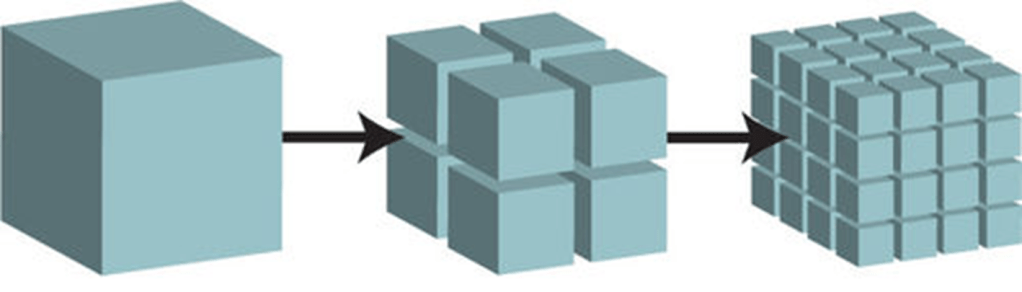
When it comes to teachers deciding what students may already know it is always better to underestimate than overestimate. If you underestimate then you only risk wasting a minute or two whilst you check for understanding and realise students can do it. If you overestimate, you risk tying yourself in knots later in the lesson and having students leave without grasping a thing. Whatever new concept you are teaching, break it down and build it up.
Well-worn path – Visit everyone but do not give them all your time equally
Do a well-worn path; this is a technique to be used whilst students are working independently. It involves mapping out a route around the classroom in which you can have eyes on every student’s work. As well as using it to check all necessary accessibility arrangements are in place (glasses, readers, dictionaries…) you can use it to check everyone’s work. It is worth starting a lap visiting your highest attainers first. These are a good proxy for any serious misunderstandings since if they are stuck it is likely everybody is and you can bring everyone back together. It is worth ending your lap with those who often require the most help. This is so that you can help them AFTER you’ve briefly touched base with everyone else.

It is OK to spend more time with some students than others. It is also OK, if there is a TA, for them to not always work with those who need the most help as the teacher may be better placed to intervene effectively. We are not aiming for equality but for equity. That involves visiting everyone but not giving your time equally.
Classroom culture – Praise effort over attainment

Maths undeniably has a PR problem. Some (most?) students will, by the time they start in Y7, already have a pre-conceived idea of how much they can achieve in maths. It’s important to build a culture where all students believe in themselves, perhaps more so in a mixed attainment setting where some will be doing maths alongside peers who are much more confident than themselves.
Take the time to praise the right behaviours that students exhibit. The peak-end rule suggests that what happens at the end of the lesson will really stick with students. To leverage this, end on something attainable, you shouldn’t be finishing your lessons with the hardest content. Treat your lesson like an exercise class and end with a warm down, not a sweat-fest. Make sure they leave feeling successful. Catch those most vulnerable doing good early on the lesson and make them feel great. In every interaction ensure that you are praising effort over attainment.
The final two are kind of cheats because they don’t apply specifically to mixed attainment maths teaching, I think they just apply to all teaching, but it can often be the case that people don’t think they do apply in this setting so I just wanted to make the point that they most certainly have a place.
Means of mass participation – who cares if less is in their books if more is in their heads

You need to have a system set up in the lesson to ensure that, as much as possible, everyone is ACTIVELY participating for as much of the lesson as they can. Mini whiteboards are the obvious (and best I’ve seen so far) solution to this. When checking pre-requisite knowledge, why ask one student when you can ask everyone? This is especially important in a less homogenous group where gaps and misconceptions can be harder to predict.
When it comes to students working in books it is nearly impossible to see everything that is happening. If more questions than usual are completed together (but still independently) on mini whiteboards then the teacher can be sure that if the need arises for students to work in books or on a sheet or something that they will be able to do so without embedding any misconceptions or being stuck. Remember that practice doesn’t make perfect, it makes permanent. Also remember that it shouldn’t matter if there is less in their books at the end of a lesson if there is more in their heads.
Explicit instruction – all the principles of effective teaching still apply

A common misconception that I see is the idea that mixed attainment teaching is not compatible with explicit instruction. This is far from the truth. It can be tempting to think that with so many different starting points in the room tasks need to be really open or many tasks need to be available. This simply isn’t the case.
When mixed attainment teaching either hasn’t been very effective for a few years or starts at once in Y8 or Y9 it’s easy to see how this conclusion is reached. With all of the above in place though, you can start from the ground and build up remembering that all the principles of effective teaching still apply.
Things to definitely avoid
As well as doing all of the above, here are some brief “do nots”:
- Do not start mixed attainment teaching at KS3 all at once, begin at Y7 and build it up
- Do not start it and THEN put the CPD in place, get the CPD sorted first then make the switch
- Do not do this TO the maths department, do it WITH them
The end and the future?
I sincerely hope that mixed attainment maths becomes the norm in the future but this is not a change that can happen quickly and I fear that we are putting more and more staff off it at the moment due to poor implementation. If the above ends up being of any use, I’ll be a happy man.
I’m always interested in what people make of this so please feel free to comment with thoughts, questions or incomplete musings. Follow this or my Twitter account Teach_Solutions for similar content in the future. Also, check out the rest of this site, there’s some good stuff knocking about the place.
 Teach Solutions