A post addressing the need for leaders to go out and visit other schools. To find best practice and bring it back to their setting instead of feeling the burden of finding new solutions to old problems.
Imagine you were working in the private sector, for a mobile phone company say. Let’s also say you measure success by how much money you make. If you had two options then, one where you unashamedly steal (with no adverse or legal consequences) all the best bits from Google, Samsung and iPhone and the other where you start from scratch and take a punt on something completely new and untested, which would you choose?
This question has an obvious answer but also due to copyright laws and patents etc. can only ever be hypothetical in the private sector.
Success in the private sector is driven by innovation. New ideas. Things that make you stand out. Something sparkly that will pull customers in. This thinking, this idealisation of being unique, seems to exist in the education sector. But should it? Can we apply the same thinking in the scenario above to the education sector?
The issue with innovation
However you measure success in education (whether it’s by results, pastoral, extra-curricular opportunities…), there are likely a dozen schools who are already doing this incredibly well and much better than you are. That’s no disrespect to your setting, it’s just likely given how many schools there are that, at least a handful, who are doing what you want to do, but better. They have already solved your problem.
There are no laws against copying an educational approach. Schools don’t patent their approach to teaching. Headteachers don’t erect walls around their schools away from the prying eyes of visitors. So why doesn’t this happen? Why don’t people just choose to visit those that are doing what they want to achieve already and implement the same thing in their own setting?
Inevitably, some tweaks, maybe some superficial changes, will be necessary to ensuring the way of working fits into a school’s unique setting but as long as the active ingredients remain, it should still be effective.
It’s hard not to think that ego plays a role in preventing this from happening. That leaders have the desire to devise their own way of doing something and won’t employ any strategy that’s used elsewhere but that can’t be the full answer. Many a time I’ve heard advice be directly given to schools to find innovative approaches to their problems. These schools aren’t top of their class and their problems aren’t unique. So why innovate? Why not send leaders out into the world to cultivate instead? To find the best of what’s out there and then use their skill and expertise to make the thing work in their own setting.
We work in such an open and giving sector, I’m yet to encounter a school that, given the opportunity, won’t open its doors to other teachers to help them out. So why doesn’t this happen more? Whatever the reason (my current theory is just that a private sector mindset has just seeped too far into the world of education) it is hurting the children we have all set out to serve.
The challenge of cultivation
Leaders in schools should see it as their job, and be empowered to, go out and cultivate the best of what is it out there. Their efforts should be spent personalising it to their setting, devising an adequate implementation strategy and then sustaining it. That is hard enough. They shouldn’t be expected, or encouraged, to find a novel solution to problems that people have already solved. They shouldn’t be wasting their time on innovation.
This still won’t be easy. It is hard to do the above. It is also hard to visit a place demonstrating best practice, getting the outcomes that you seek, and for one to decode what the active ingredients are. It is so easy to walk away with a superficial takeaway which is easy to implement but ultimately ineffective by itself (see the dangers of that here).
A plea
The next time you have a problem to solve in a school. Like a really big problem. How to increase attendance? How to increase results? How to decrease suspensions?… Don’t feel like you need to find a new solution. Go out and visit places, see what works, and then think about how you can take this tried and tested process and make it a success in your setting.
School leaders should be encouraged to cultivate the best of what is out there, they shouldn’t be wasting time needlessly trying to innovate. There is no shame in that and, ultimately, the children we serve will benefit.
This blog gives advice for all the things teachers should and should not be doing in that run up to exam season
A while ago I wrote a blog aimed at giving tips on how to start strong with a new class at the start of a year, it’s here and was called “Starting Strong”. As the countdown to exams have started it felt right to close the loop with this one.
Here are some dos and don’ts for working with pupils as their exams beckon. I am going to focus this around Y11 Maths in England but I suspect it wouldn’t take too much work for someone to decide what parts would apply to them with a different subject/country/age-group.
Let’s start with 7 “don’ts”. These are things I see often enough that they warrant a warning sticker.
Don’t make them sit paper after paper
It’s important to remember that students aren’t going to start learning any differently just because exams are nearer. Don’t put one lesson a week aside for them to complete an exam paper if you haven’t had time to address all the major gaps in their learning from the last one. This is a form of “means end conflation” but getting them to sit lots of papers is not necessarily going to make them any better at completing them.
Don’t review papers by going through them one question at a time
If students have completed a paper, it isn’t a good use of their time to simply see the teacher go through it on a visualiser whilst they self-assess. If the pupil has got a question correct, they learn nothing. If they got it wrong, they need some teaching and purposeful practice on whatever the concept is. If students learnt an idea by simply seeing a teacher complete one very specific example one time and then moving on straight away, teaching would be a very easy profession.
Don’t intervene by grade
Don’t make intervention groups purely based on grade. Identify key areas of curriculum weakness and group them by these where possible.
Don’t assume students know how to revise
Don’t set homework of just “revise” unless you have explicitly taught them how to do this. Even then, be as specific as you can.
Don’t overload them with resources
It isn’t helpful to give them 2 revision guides, 6 exam papers, 10 knowledge organisers, and 3 websites to use. Yes, you will give students all the tools they may need but this is overwhelming and lacks accountability. Keep things tight and achievable. Find one or two great resources and invest in these. Less is more.
Don’t try and cover everything
It isn’t ideal to cover every aspect of the curriculum if it means a large part of it won’t be learnt well. Making the hard decision to cut content, but learn fewer things well, can lead to students performing better in their final exam.
Don’t think you’ve ever “completed” the curriculum
This one is just a little bugbear but I often hear the phrase that a certain class has “completed/finished the curriculum”. I then look at data and they aren’t all achieving 100%. It makes me wonder in what sense the curriculum has been completed. It would be equivalent to painting a patchy first coat of paint on a wall and saying, well, I’ve covered the whole wall so I’m lost for what to do next. The curriculum is not a thing to be completed, it’s a thing to be taught, studied and learnt.
Don’t do this!
Let’s move on to some “dos” then. Some of these are a cheat because they are the opposite of some above but, it still counts.Most link to bigger ideas in blogs I’ve written previously. Check any out that you may be unfamiliar with.
Focus on exam technique
Knowing the course content is one thing, but there will be advice you can give which is specific to the way the exam is assessed or written. I think, in maths, the difference between two students with equal maths knowledge but with opposite exam techniques can easily be a grade. See here for how to get more marks on a maths paper without knowing any more maths.
Use QLAs effectively
Instead of going through an exam paper from front to back, use QLAs wisely. Advise on that here.
Share your plans with the students
When you’ve created your plan for your final run of lessons, share this with pupils. That knowledge, combined with them having ownership of their own most up to date QLAs will let them know the small subset of topics that they will need to revise independently because it won’t be covered with everybody in class.
Feedback effectively to assessments
I wrote in the “don’ts” the ways you shouldn’t feedback to an exam, here’s how to do it well.
Teach them how to revise
Revision is hard and effective revision can sometimes be counter intuitive. Teach them how to revise. For more on that, see this blog.
The Main Point
It is so tempting to feel the need to drastically change things up as exam seasons gets closer and closer. It is your job, ultimately, to still teach students how to do things they cannot do. This has been your job all through the year with every year group you teach. Hold fast and carry on doing the same thing. Keep the balance of modelling and practice. Keep the balance of checks for understanding and responsive teaching. The only thing I can see a good argument for changing is the ratio of time spent retrieving content, simply because by this point there is so much more to retrieve. It can be hard to resist the urge to change things up but if you believe you’ve been doing a good job for students the rest of the year, there is nothing special that needs to happen. Hold fast. Stay the course. You got this!
We’re used to thinking about winners are losers, and this summer of sport has been no different. But how can this lens be a used productively when thinking about results day?
As the Euros blurred into Wimbledon which in turn blurred into the Olympics, a summer of sport is soon going to take a hiatus for the most important competition of the year; results days. Whilst the rest have very clear definitions of what winning looks like, results day does not.
This is an incredibly fitting reference for this blog but is also very niche (2 points if you got it)
It’s likely your school will have numerical targets that have been set which may or may not end up being met… but there are no winners, not officially. Some schools will top league tables for various metrics but there are over 3,400 schools in England so does this mean there will be a handful of winners and a hell of a lot of losers. That doesn’t seem right though, not when so many schools are working hard, doing the right thing, and making good progress. It’s time to rethink how schools interpret results day. Let’s do that through answering a series of questions.
Here are the questions:
Is competition OK?
How should results be analysed through the lens of school improvement?
How much improvement is enough?
Is competition OK?
100% it is. Teachers are some of the most consistently competitive people I’ve ever met. Competition is no bad thing and, when gone about the right way, can be a powerful and useful leverage. Just be very careful who you get into competition with. There are some amazing schools out there and some of those will likely have a similar demographic to you. There are state schools delivering transformational educations in inner city, rural locations, coastal settings… using these, especially those in a similar situation to yourself, for inspiration makes perfect sense, but for competition does not.
The only school I think is worthwhile any school being in competition with is itself. Schools leaders inherit schools in various states and the only requirement on them should be to try and work towards improving the school at the quickest rate they can whilst remaining sustainable in the long run. Competing with an established school that has been doing this longer than you, is like trying to win a race against an Olympic athlete who already has a head start.
In some years this might mean an increase in exam results is expected, in others, if there have been massive staff shortages, local troubles, finance issues, strikes… then even maintaining results could be considered a win. Context is king here.
How should results be analysed through the lens of school improvement?
The short answer to this is: CAREFULLY!
Let’s say you’ve visited a school that you love. It’s results are amazing, it’s staff and students are happy. It’s everything you ever wanted to create. Let’s then say that you spent last year building that in your school and it was a success. If all that has happened then your results that year still aren’t even going to be close to emulating the results of the other. Results are the slowest thing to be affected by school improvement initiatives. Why is this? Simply it’s because results aren’t the result of the current state of the school but the culmination of a learner’s entire journey through it. No matter how good a student’s Year 11 experience is, no matter how much intervention you threw at them, how much you spent on residentials, nothing even comes close to the power of 5 years of consistently high-quality teaching.
This means new initiatives should not be abandoned just because they appear ineffective in the short term. A sensible follow-up question this does raise is how do you know if something IS working?
Well, the safest thing to do here is not to innovate but to personalise. We know enough about what works to know that if you are leading in a school or department sitting outside the top 5% performing then it shouldn’t be your job or responsibility to invent something. It should instead be to implement something which has been proven to work elsewhere in a similar setting. This still will require levels of personalisation as, no matter how closely aligned to your setting it is that you can find a great school, yours will be unique and strategies will need adapting. You need to focus on the active ingredients of what made it work for the other school. (For an example of this when it comes to the effective teaching and learning, check out the T&L Framework here: https://teachsolutions.uk/files-and-documents/).
There is too often a need in education for people to reinvent the wheel, to discover some new silver bullet, to innovate. In education, you don’t need a USP, you don’t need to compete with the market in the same way that Samsung and Apple do, you can shamelessly copy what works without fear of being sued, so do it! Take the 90% of the active ingredients that make great schools great and use them. Just be careful not to visit a school and then only take the easy superficial stuff (for more on that idea, read this https://teachsolutions.uk/2023/07/18/buying-coconut-oil-didnt-give-me-a-six-pack/).
Too often also, school initiatives belong to individuals, rather than to the school. School’s policies, visions, systems… should reign supreme here. Anything major that a leader starts, should be approved from their line manager with careful thought about how this work can, if successful, be continued when the leader leaves the building. What documentation exists? What writing exists? Senior leaders tend to stay in schools from between 4-7 years. That is just over 1 full cohort of Y7-11 going through. To ensure that the school doesn’t have to start again from scratch but that systems can be tweaked, rather than created anew, structures (and not just temporary scaffolding) need to exist which ensure the school can continue to move from strength to strength.
How much improvement is enough?
If we change what winning looks like to thinking about improvement, year-on-year, a very reasonable question is “how much progress is enough?”. This is a tricky one. At this point I can only comment on what I have seen and lead on myself. As a head of department in a school with supportive systems, a fully staffed department (though with our fair share of ECTs), we managed a consistent 0.45 progress increase year on year from 0 when I took over to 1.8 the year after I left. That is a target I informally set heads of department to make (whilst appreciating there are lots of mitigating circumstances that might make it not possible). Whatever other metrics you might have in place, at the end of day, there should be a real impact on the children being served and, although it might not be how we would always want them to be judged, the outside world treat exam results as a keys where the higher the results are, the more doors you can open. Until that changes, exam results are crucial when judging our impact as educators.
The big day
When the day comes then, take time to celebrate successes, to congratulate colleagues, to spend time celebrating with proud students and their families and consoling/coaching those who are less happy. Then, when it comes to doing the analysis, be sure to not look around the country and your local area so much but look at your past self. When drawing up or editing school improvement plans, don’t throw everything away if you’re not happy, remember that change, real change, takes time.
The content discusses the impact of immediate feedback on learning. It highlights the importance of independent feedback loops in subjects and suggests strategies for creating effective feedback in different learning scenarios.
Imagine you are at a carnival. There is a target you need to hit with a bow and arrow. There is also a blindfold which you have to wear. The person running the stand shows you where to aim and models themselves doing it perfectly and hits the bullseye. Now it’s your turn. You have 10 attempts. You also have the choice between two different scenarios you can choose between.
Scenario A – You can remove your blindfold after each attempt to see how close the last shot was.
Scenario B – You have to wait until all 10 of your attempts are up before removing the blindfold.
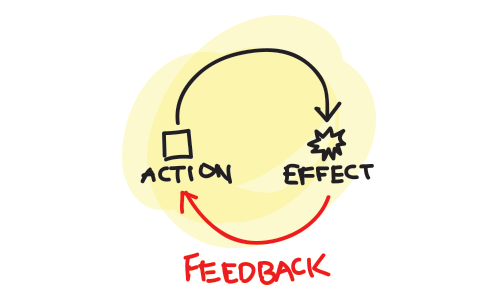
Which scenario is going to yield the better result? Undeniably, it’s going to be A. This is despite both involving the exact same modelling and equal opportunities to practise. It’s because A has the advantage over B in allowing you to adjust your practice based on the near-instant and ongoing feedback.
Let’s call scenario A an “independent feedback loop”. This is where the user receives feedback which they can act upon instantly with no direct input from another expert needed, and now let’s move this into the classroom. How do independent feedback loops play out at school.
Some subjects lend themselves naturally to these loops. When teaching a serve in tennis, certain techniques in art, music, DT…. The practical subjects where there is a clear model of excellence and the user can see instantly the difference between what they are producing and what they should be producing. Compare this to completing a set of maths questions, analysing an historical source or writing a piece of fiction and suddenly the benefits of an independent feedback loop disappear. The question of this piece is, for situations like those just mentioned, can an independent feedback loop be created and, if not, what’s the closest we can get to simulating one?
Let’s start off with a maths example. Scenario B would translate as students working away at 10 questions and then, once they are all done, the teacher shows the answer to the class and they find out how they have performed. Some might find out they have got everything wrong, some only parts and others might be relieved to get 10/10. For those who got some or most wrong, their time spent practising at best was a waste and at worst has helped embed some misconceptions which might move learning backwards for them. Now, if a lesson does get to this point, the teacher would have a variety of options open to them, but this article is exploring if anything could have been done during the practise phase of the lesson.
Subjects where there is a pre-determined correct response.
1. Don’t wait until the end to share the answers: When questions involve multiple steps and there is no way that students could just pluck the answer out of thin air, there is no harm in sharing answers alongside the questions straight away. The usual safeguard of protecting against copying is not needed since the working out is what will hold them accountable. If questions can be solved with no need to show working out, then having an “answer bank” which has all the answers but in a random order displayed, can achieve a similar effect whilst maintaining high levels of accountability. What this won’t do is tell the students where they went wrong. It might encourage them to check their work and they may be able to self-correct. At the very least though, they will know they need some help before continuing.
2. Combine the above with backwards faded examples: If the problems require multiple steps to complete then, by using backwards faded examples which add an extra step as the questions develop, combined with answers being shared, leaners will be able to pinpoint the exact step at which they have a gap in their learning. That knowledge combined with clear notes or examples, should help them self-correct. The worst-case scenario here is that the student knows specifically what they can’t do but is unsure on how to correct it.
3. Build self-checking mechanisms explicitly into the task: If it’s possible to equip learners with the skills to check their own work, that would be ideal. In certain questions where answers can be self-checked with substitution or some other process, teachers should make it an explicit part of the task that is being completed. Instead of the question only saying “solve this…”, including a part which says “using substitution, check your answer”. Estimating answers beforehand can also be a useful tip.
Again, do not rely on learners doing this themselves, adding in an initial part as “estimate your answer to the question” before asking them to solve it, will help encourage these behaviours. Estimating and checking are both things learners are often asked to do implicitly but without making it an explicit part of the question it will not happen and never become a habit. Too often students will do the minimum required of them so if the wording in the question (the ultimate source of authority here) doesn’t ask for something, it is less likely to happen.
Subjects where there is no one right answer and also no in-built independent feedback loop
1. Clear and sequenced success criteria: Giving learners explicit success criteria to hit at specific points can help them self-assess their work. Giving a physical checklist containing targets like “in paragraph 1 make sure you include…” or “in your final paragraph make sure you refer back to…” can help learners assess and improve their work as they move through it. Where the success criteria is less pinned to a specific part of their work, a checklist can do the same thing. Asking learners, after an allotted amount of time, to highlight in their work where they have hit the criteria that they are aiming for can help them reflect and improve.
2. Share examples and non-examples before the end: Pausing learners and sharing some great exemplars and some misconceptions can also help learners reflect on their own work. Again, it’s important this is done before the end of their allotted practice time. When doing this it is important that the teacher ensures everyone understands the underlying properties that make the work being shared good or bad. Everyone’s work will be different and it’s important that the essence of what makes it great or not is discussed, beyond just the superficial content of the work.
Summary
Teachers can do a lot before independent work starts to check learners are as ready as possible and they can do a lot after independent work finishes to rectify any mistakes that have emerged. Let us not forget that there is also plenty that can be done, through careful thought and task design, to ensure that time spent practising is always time well spent.
I’m always interested in what people make of this so please feel free to comment with thoughts, questions or incomplete musings. Follow this or my Twitter account Teach_Solutions for similar content in the future. Also, check out the rest of this site, there’s some good stuff knocking about the place.
Ever wondered why ancient buildings are so beautiful and strong that not only are they are still around today, but they can also still create such awe and wonder? “We don’t make ‘em like we used to”, hey. To find out why this is the case, we will travel back to WWII.
When planes were sent over in the war effort their damage was analysed upon their return. This was to see where reinforcement should be placed in order to better protect them from enemy fire.
Analysis of all the places planes are being shot at, like in the image on the left, would let engineers know where to add extra armour. The aim here was to ensure more planes returned home than previously. Armour was added to the red areas, since this is where the data suggested the enemy guns were hitting, and planes were sent out again. Unfortunately, it had little impact.
Enter Abraham Wald. He was a Jewish Hungarian, who, when antisemitism rose in Europe, moved to America. When the war broke out, he was at hand to aid to Allied effort. Like so many unsung heroes of WWII, he was a mathematician. He said that if we only look at the bullet holes of the planes that have survived then we are leaving out a crucial set of data, those that did not.
Whilst it would be impractical to go and find the planes that had been shot down, perhaps we could infer this information from the survivors. If we look again at the image of the plane and realise that these are the bullet patterns of the planes that have returned, it suddenly isn’t a big leap to say that the armour should go where the red dots aren’t. It is likely the planes are being shot everywhere but, since we can’t see any planes that have been shot in certain areas, this is more likely due to shots there being devastating to the plane, rather than that area being missed.
This is an example of survivorship bias – only looking at the data of those that have “survived” to inform your decisions. This is also the reason why it can appear that all ancient buildings are strong and awe-inspiring; the reality is those that weren’t have either collapsed because they weren’t sturdy or have been demolished because they weren’t impressive. There is little choice but for the ancient buildings that are around today to be strong and beautiful, they wouldn’t be here otherwise.
What does this have to do with education?
It is not uncommon to see in the public domain, people deriding the use of explicit methods of teaching. Phonics and fronted adverbials are common targets here.
An author (as all the people above are), criticising how reading is taught in schools is another example of survivorship bias. They think that, understandably, they managed to flourish without needing these methods so therefore it isn’t needed for anybody. What they are omitting from their data is the thousands of pupils (more likely than not, disadvantaged pupils) who left the education system the same year as them with little to no literacy. This explicit teaching is not for the few who survived, it is for those who otherwise wouldn’t.
“Since the introduction of the phonics screening check in 2012, the percentage of Year 1 pupils meeting the expected standard in reading has risen from 58% to 82%, with 92% of children achieving this standard by Year 2.” DfE
What about teachers? Do we carry this bias around with us and how might it present itself? If you’re teaching in a school the chances are you have a degree, for that, you probably did pretty well at school. Whatever your background, you most likely found ways to navigate the system. This can lead to assumptions about all learners. It can lead to assuming that others don’t need certain structures put in place because you survived without them. It can lead to people deriding, not explicit ways of teaching vocabulary, but explicit ways of teaching anything.
If you’ve successfully navigated school and are now a teacher, you might ask:
Why do I need to explicitly teach learners how to revise?
Why do I need to teach self-regulation?
Why do I need to use routines in my lesson?
…after all, I survived without them.
If you’ve successfully navigated being a teacher, and are now leading teacher in some way you might ask:
Why do we need these frameworks and policies?
Why do I need to show others how to explicitly teach/plan?
Why do I need to share my tips for teaching?
Why do I need to line manage people so explicitly?
…after all, I survived without them.
It’s important when systemising processes and making things more explicit that we do not take agency away from individuals and that our plan, in the long run, is for them to be successful independently of us. Our aim is to produce a cohort of staff and students who don’t just survive but thrive in the education system. To do this though, we need to look beyond the success stories, the top sets, the high fliers, and think about those that might be struggling and what extra armour needs putting in place to ensure they succeed too. After all, a bit of extra protection, if you don’t need it, does no harm.
Summary
It is important to know that in many ways, you are a survivor. This is something to be celebrated but also something to be acutely aware of. As a teacher, you likely need to give many students more explicit help then you ever received yourself. As a leader, you likely need to give many teachers more explicit help than you ever received yourself. Remember, this isn’t for those people who are going to be fine otherwise (though they are likely to benefit too), it is to ensure that no matter what, when you work or learn at a great school, you have just as much chance of succeeding as anybody else. In short, make sure you know where your holes are, or perhaps more aptly, where they aren’t.
I’m always interested in what people make of this so please feel free to comment with thoughts, questions or incomplete musings. Follow this or my Twitter account Teach_Solutions for similar content in the future. Also, check out the rest of this site, there’s some good stuff knocking about the place.
Advice on how mixed attainment maths at KS3 can work
I am both a big advocate for and against mixed attainment maths teaching at Key Stage 3. When done right I believe it is better both academically and ethically for the children. I know it can work, I’ve seen it work, I’ve been the Head of Department of a school that taught mixed attainment maths in KS3 and got some of the highest progress scores in the country. I have no doubt it can lead to incredible outcomes. The difficulty comes in “doing it right”. It takes A LOT to do this. And the risk of not getting it right I believe is greater than when teaching more homogenous groups. It’s a high risk high reward strategy.
What worries me is that people may make the ideological choice to move to mixed attainment teaching, or they may do so for some other logistical reason (staffing, timetabling…), and although it may be worthwhile in the long run, if it isn’t implemented right in the short-term it can be detrimental to all involved. Staff can be overworked when suddenly shifting to a whole new pedagogical approach and students end up receiving a worse education than they were originally. In the worst cases this is not only done without consulting the maths team, it is done against their own desires. Whilst it might be OK in a few years, there is an initial cohort of both teachers and learners who suffer needlessly in the immediacy.
Maths is innately more hierarchical than most other subjects and the decision to teach it in mixed attainment groups must be deeply considered by school leaders.
Below I want to go through some of the key principles that I have seen and used that have made it work in practice. These often are not things which can be implemented overnight.
The key points I’m going to speak on are:
The curriculum
Early intervention
Atomisation
The well-worn path
Effort over attainment
Means of mass participation
Explicit instruction
Curriculum – A rising tide lifts all ships
One of the biggest issue in mixed attainment maths teaching is students not having the pre-requisite knowledge to engage meaningfully in things their peers can. The department should still endeavour to teach the entirety of the KS3 curriculum but this needs to be done over 3 years. They should ensure that none of the topics that sometimes “leak” into Y7-9 from KS4 appear (factorising quadratics, solving simultaneous equations algebraically, index laws…). The scheme of work needs to go back to basics and build up slowly. It should start with numeracy and the basics need securing and mastering.
There are plenty of rich activities which can be used to both challenge students whilst helping others practice. If some students need “stretching” then exercises should go deeper rather than broader with the key concepts being taught. It is impossible to perfectly cater for all students all the time.
Teachers should be secure in the knowledge that, over 5 years, students will encounter all the content they need to get 100% in their GCSEs. They shouldn’t worry about holding a few students back in the short term for the betterment of all in the long run. Holding some students back to ensure all can access the content is better than the converse of letting some fly whilst others never master the basics. My second in department used to routinely remind me that “a rising tide lifts all ships”.
Early intervention – Build on solid foundations
Linked to the above, if there are students who join you in Y7 who cannot access the beginning of your course due to weak numeracy then you need to intervene. This should be a relatively small number of pupils. The culture around intervention needs to shift from happening at the end of Y11 to the start of Y7. Intervene early. Either employ or upskill staff on the teaching of Ks1-2 maths and put all the effort you would put into Y11 in the run up to their GCSEs into identifying and addressing serious gaps at the start of Y7.
This is the strategy that all schools should be using anyway, since if you sort the basics out then students will spend the rest of their time on the course building on solid foundations.
Atomisation – Break it down and build it up
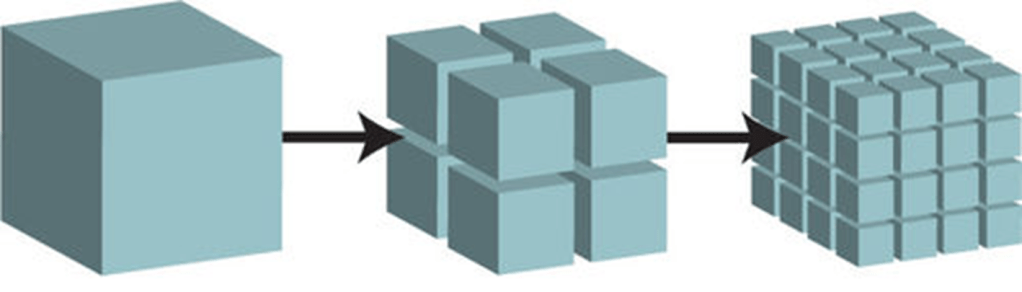
Before teaching any new concepts teachers should go through a rigorous process of “atomisation”. Of breaking the concept down into the component parts that make it up. They should go through the list and decide what they can safely assume students know, what is essential to master this new concept, and what might be a “nice to have”. All of the essentials should be checked or reintroduced in the lesson prior to teaching the new content.
When it comes to teachers deciding what students may already know it is always better to underestimate than overestimate. If you underestimate then you only risk wasting a minute or two whilst you check for understanding and realise students can do it. If you overestimate, you risk tying yourself in knots later in the lesson and having students leave without grasping a thing. Whatever new concept you are teaching, break it down and build it up.
Well-worn path – Visit everyone but do not give them all your time equally
Do a well-worn path; this is a technique to be used whilst students are working independently. It involves mapping out a route around the classroom in which you can have eyes on every student’s work. As well as using it to check all necessary accessibility arrangements are in place (glasses, readers, dictionaries…) you can use it to check everyone’s work. It is worth starting a lap visiting your highest attainers first. These are a good proxy for any serious misunderstandings since if they are stuck it is likely everybody is and you can bring everyone back together. It is worth ending your lap with those who often require the most help. This is so that you can help them AFTER you’ve briefly touched base with everyone else.
It is OK to spend more time with some students than others. It is also OK, if there is a TA, for them to not always work with those who need the most help as the teacher may be better placed to intervene effectively. We are not aiming for equality but for equity. That involves visiting everyone but not giving your time equally.
Classroom culture – Praise effort over attainment
Maths undeniably has a PR problem. Some (most?) students will, by the time they start in Y7, already have a pre-conceived idea of how much they can achieve in maths. It’s important to build a culture where all students believe in themselves, perhaps more so in a mixed attainment setting where some will be doing maths alongside peers who are much more confident than themselves.
Take the time to praise the right behaviours that students exhibit. The peak-end rule suggests that what happens at the end of the lesson will really stick with students. To leverage this, end on something attainable, you shouldn’t be finishing your lessons with the hardest content. Treat your lesson like an exercise class and end with a warm down, not a sweat-fest. Make sure they leave feeling successful. Catch those most vulnerable doing good early on the lesson and make them feel great. In every interaction ensure that you are praising effort over attainment.
The final two are kind of cheats because they don’t apply specifically to mixed attainment maths teaching, I think they just apply to all teaching, but it can often be the case that people don’t think they do apply in this setting so I just wanted to make the point that they most certainly have a place.
Means of mass participation – who cares if less is in their books if more is in their heads
You need to have a system set up in the lesson to ensure that, as much as possible, everyone is ACTIVELY participating for as much of the lesson as they can. Mini whiteboards are the obvious (and best I’ve seen so far) solution to this. When checking pre-requisite knowledge, why ask one student when you can ask everyone? This is especially important in a less homogenous group where gaps and misconceptions can be harder to predict.
When it comes to students working in books it is nearly impossible to see everything that is happening. If more questions than usual are completed together (but still independently) on mini whiteboards then the teacher can be sure that if the need arises for students to work in books or on a sheet or something that they will be able to do so without embedding any misconceptions or being stuck. Remember that practice doesn’t make perfect, it makes permanent. Also remember that it shouldn’t matter if there is less in their books at the end of a lesson if there is more in their heads.
Explicit instruction – all the principles of effective teaching still apply
A common misconception that I see is the idea that mixed attainment teaching is not compatible with explicit instruction. This is far from the truth. It can be tempting to think that with so many different starting points in the room tasks need to be really open or many tasks need to be available. This simply isn’t the case.
When mixed attainment teaching either hasn’t been very effective for a few years or starts at once in Y8 or Y9 it’s easy to see how this conclusion is reached. With all of the above in place though, you can start from the ground and build up remembering that all the principles of effective teaching still apply.
Things to definitely avoid
As well as doing all of the above, here are some brief “do nots”:
Do not start mixed attainment teaching at KS3 all at once, begin at Y7 and build it up
Do not start it and THEN put the CPD in place, get the CPD sorted first then make the switch
Do not do this TO the maths department, do it WITH them
The end and the future?
I sincerely hope that mixed attainment maths becomes the norm in the future but this is not a change that can happen quickly and I fear that we are putting more and more staff off it at the moment due to poor implementation. If the above ends up being of any use, I’ll be a happy man.
I’m always interested in what people make of this so please feel free to comment with thoughts, questions or incomplete musings. Follow this or my Twitter account Teach_Solutions for similar content in the future. Also, check out the rest of this site, there’s some good stuff knocking about the place.
This post is about the common pitfalls in departments who use centralised planning. It discusses the issues and offers solutions.
A while ago I was invited onto Craig Barton’s Tips for Teachers podcast. I had to think of my top 5 tips I wanted to share with folks. The second one I went for was “leave a legacy”. This was about ensuring that when you leave a school or a position in a school that you have put systems in place that exist outside of the individual. That when you leave, your successor has something to build upon, rather than something which was only in place because it existed on your shoulders which will crumble when you leave.
A key aspect of this is for heads of department are the implementation of centralised resources. I firmly believe that any department head who does not advocate for this approach is doing a disservice to both their students and staff.
I encounter lots of schools trying to implement this (which is great!) but I sometimes see some barriers which prevent it from being as effective as it could. This post is about exploring those reasons and giving some antidotes.
This post comes with a health warning though because the reasons are incredibly dull. Vitally important. But dull as dishwater.
Centralised Planning
Quickly, before diving in, I just want to clarify what I mean by centralised planning, just in case it means something different to you. A department that uses centralised planning would have “base lessons” that are produced by members of the team and quality assured by leaders. These capture the key curriculum aims, contain pre-agreed models of working, and fit whatever lesson structure the school or department has. These then need to be personalised by every teacher before delivery to ensure it is bespoke for the unique group of individuals in that class.
Staff should still feel that they have the autonomy to personalise these resources but only to an extent. It must not jeopardise a consistent and high quality curriculum being delivered for the students over the time they study the course.
The benefits of centralised planning to the students far outweigh any negatives and, with the considerations below, most of the main criticisms laid against it (leading to lazy teaching, stripping all autonomy from teachers…) are mitigated against.
It does undeniably take some autonomy away from teachers but if what one individual wants to do is better then it should become the new normal for the department. If what that individual wants to do is worse, then it shouldn’t happen.
If this, or some version of it, is not in place then you do not end up with a department, you just have a group of individuals who happen to teach the same subject in the same building.
Reason #1
Online folder structures.
There it is. I told you it was dull. But, you’ve made it this far so let’s keep going.
The way that leaders choose to organise their subject area on whatever cloud-based systems their school uses can make or break centralised planning. Leaders need to ensure that all the base lessons are available, sure, that’s the easy bit.
They, more importantly, also need to ensure that they can access all of the adapted versions that their staff produce. Staff should not be operating in silos and saving things in some private area. The work they produce should be readily available to all. This is because:
Improvements compound – The base lessons won’t be the best and changes/additions that staff make will in some cases improve the quality of the resource. These need saving centrally so that over time the resources go from strength to strength.
Adaptations exist – Certain classes will contain students with additional needs (lower reading ages, colour blindness, weak numeracy…). When staff make these adaptations once and save them centrally, they will not have to be adapted from scratch if classes with similar needs need teaching in the future.
Quality assurance – Leaders need to ensure that engagement with the resources is happening and getting into every lesson is not feasible. Having access to all resources is though. This helps with quality assurance, the sharing of good ideas and with accountability for all staff.
Cover/Absences – If students are absent or if classes need emergency cover leaders having access to upcoming or previously taught lessons saves time.
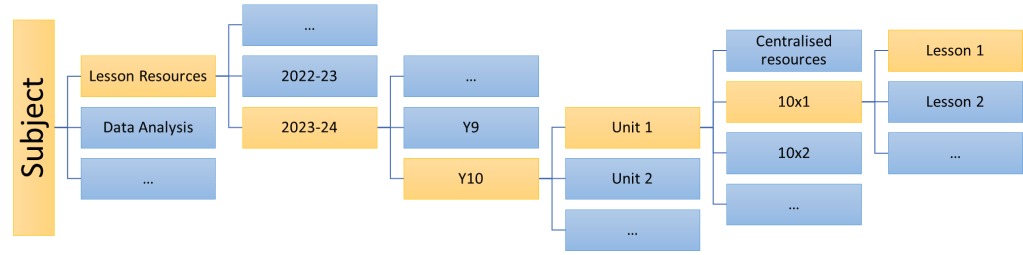
The folder structure should not be designed around staff having their own spaces within a shared area but should be designed around the learning experiences of the pupils. I.e. folders should be grouped by year group and unit, so that it is easy to navigate a child’s learning experience rather than an individual teacher’s experience.
Example structure:
Reason #2
Live modelling
When producing centralised resources it can be useful to pre-populate or pre-animate models and processes which need teaching. There is nothing wrong with this in and of itself. It can help ensure that there is a consistency in the delivery of key concepts in the department which will help students over time.
The danger comes in teachers not getting rid of these by the time it comes to them delivering the lesson. When modelling it MUST be done live. Whether that’s on a visualiser or a relatively blank board it doesn’t really matter. What is important is that the teacher knows, by the time they deliver the lesson, that they cannot “outsource” the teaching.
Reason #3
Medium-term plans
When teaching with centralised resources it can be easy to go from one lesson to the next without having a sense of any overall aim or important threads throughout the unit. Staff should engage with the unit as a whole in advance of teaching the first lesson and produce their own sequence of what their lessons will cover. This may involve merging or splitting existing resources to cater for the specific needs of their class. It should also involve a brief conversation before the teaching each unit (I’m saying a unit will last roughly a half term), with them explaining to a peer any adpatations they’ve made and why and demonstrating an understanding of what the unit’s purpose and aims.
Overview
Centralised planning saves time, increase the quality of resources in a department and ensure that students get a consistent curriculum experience with the same models/metaphors/scaffolds… used throughout. It is a worthy aim but takes time and effort to implement well.
Folder structures, ensisting on live modelling and engaging in personalised medium-term planning all help ensure it ends up being more effective than it otherwise could be.
I’m always interested in what people make of this so please feel free to comment with thoughts, questions or incomplete musings. Follow this or my Twitter account Teach_Solutions for similar content in the future. Also, check out the rest of this site, there’s some good stuff knocking about the place.
This post looks at certain topics which are often neglected when it comes to retrieval, why that happens, and what can be done about it.
Let’s start with a quick question. What seemingly accessible topics in your subject do students never seem to be able to remember?
In my subject, this is an easy one. Ask any maths teacher and their list will most likely include:
Loci
Constructions
Congruency
Simultaneous Equations
Cumulative Frequency Graphs
Averages from a table
Retrieval
Retrieval, retrieval, retrieval. It is a necessary part of learning (remembering?). Learning, not just performing, does not happen when something is seen once and then never again. You need introducing to something, you need to almost forget it, then you need to rescue it from your mind before it fades away just in time to keep it in your head for that little while longer.
In mathematics, some topics are naturally retrieved. With no effort from the teacher they will recur again and again. If we take solving two-step equations as an example, once taught as a discrete topic, it will rear it’s cheeky head when students move onto:
Forming and solving equations
More complex linear equations e.g. three step or with unknowns on both sides
Simultaneous equations
Quadratic equations
…
If we take basic angle facts, these will reappear when moving onto:
Angles in parallel lines
Forming and solving equations
Certain ratio problems
Angles in polygons
Circle theorems
Bearings
…
Why does this matter?
Retrieval, retrieval, retrieval. It’s just so important in embedding content, it means that the ideas above that recur are more likely to be learnt (remembered?).
A Curriculum Tree
If we imagine a tree of maths knowledge representing a curriculum. In this tree, the core ideas which appear everywhere form part of the sturdy trunk. Let’s imagine branches grow from pre-requisite materials, these more fundamental ideas mentioned above would form some of the more solid parts which would have many offshoots. As we track any branch to its end, you would find a topic that is not needed for any other topic for that curriculum.
The closer a topic is to the trunk the more naturally it will be retrieved. The topics at the end of the branches, however, are not going to naturally be retrieved whilst going through a curriculum. This is a problem. Why? Because retrieval, retrieval, retrieval, is so important to remembering (learning?).
Ends of the Branch
Because of how important retrieval, retrieval, retrieval is to learning (remembering?) we need to pay special attention to the ends of the branches. These will not recur naturally so we must find ways to force them into the curriculum. Most schools in the UK these days achieve this at the start of the lesson with some sort of retrieval activity. I think this is a great idea. Without revisiting content regularly there is a risk of it not being remembered and the start of the lessons seems a better place than most in which to do this.
It follows (if you believe all of the above) that the topics at the ends of the branch need special care and attention when designing these retrieval tasks. Beware the end of branches!
This all seems simple enough. Problem solved, right? Well, hold up a second.
There are some topics that, for various reasons, just complicate things.
I see hundreds of lessons a year and am yet to see a retrieval starter in which students need to recall loci or constructions, and very few where they retrieve cumulative frequency graphs, averages from a table or simultaneous equations etc. Does that list look familiar? (Don’t worry if you’ve forgotten it, we haven’t retrieved it yet), but it’s the list that we started this post with.
There is an uncanny crossover between what I do not see retrieved and the seemingly accessible topics that teachers will proport students struggle to remember. Could it be that it’s because students are not asked to retrieve this content as often? I would say so.
It’s perfectly understandable that this happens though. Nobody wants to spend the beginning of their lesson retrieving loci or constructions because it will inevitably lead to chaos as students do not have the necessary equipment.
Cumulative frequency graphs and averages from a table questions will require printing which is logistical barrier.
Simultaneous equations and congruency questions often require so much writing they may not fit into a snappy 5-minute starter routine your school so heavily insists on.
Solutions
If you or your department uses starts of lessons in this way then please beware the ends of branches. Not all of them, but those which require that little extra consideration. These can be easy wins but without putting in that extra effort every now and then to ensure students retrieve these topics, they are doomed to be forgotten (not learnt?).
Remember:
Take time to mark out explicitly when teachers should be reviewing these
Have some pre-prepared printable sheets ready
Have a class-set of equipment on standby for certain weeks
Be ready to (justifiably) take that little bit longer on the starter
Without taking special care, some branches will never be able to blossom.
I’m always interested in what people make of this so please feel free to comment with thoughts, questions or incomplete musings. Follow this or my Twitter account Teach_Solutions for similar content in the future. Also, check out the rest of this site, there’s some good stuff knocking about the place.
A summary of revision tips for teachers to use with students.
In the run up to exams students should be spending about as much time at home revising as they spend in school working. That time is valuable. It adds up so much that it is worth spending some of the time in school to ensure that students actually know how to revise so they don’t fall into any bad habits that waste their time.
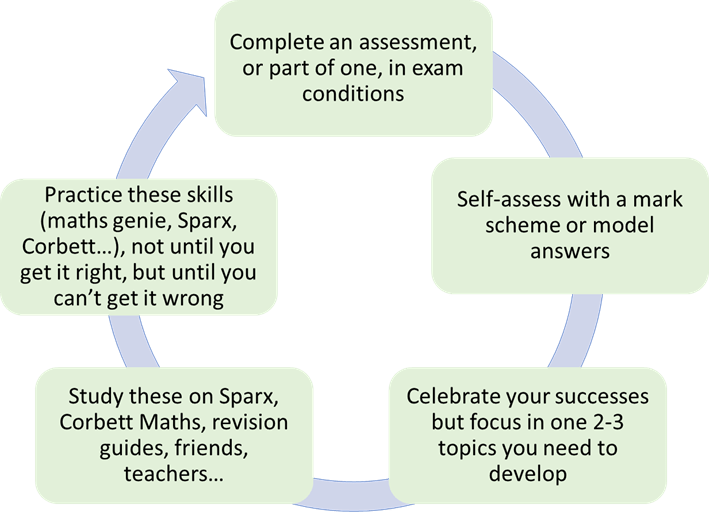
Here are things we can do as teachers to ensure the time they are spending revising independently is as effective as possible.
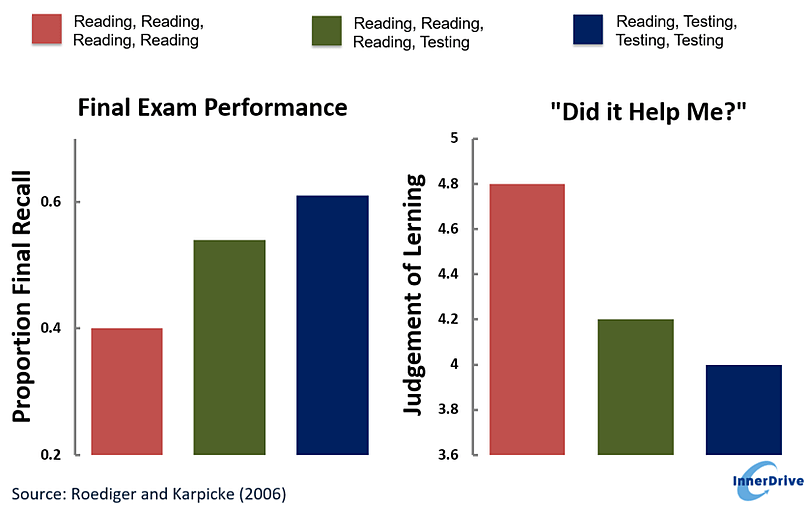
Let them know that ACTIVELY revising is going to be far more effective than PASSIVELY revising. Passive revising includes things like reading, highlighting, copying… and is not a great use of their time. Think of an analogy of working out at the gym; if their head isn’t hurting at the end of revision session, they aren’t doing it right.
2. Don’t overload students with resources. Giving them too much at once is not a kindness. This can be overwhelming and less work can end up being done compared to if a smaller, more accessible task was handed out. Keeping revision simple, one online resource, one workbook, one paper at a time can help.
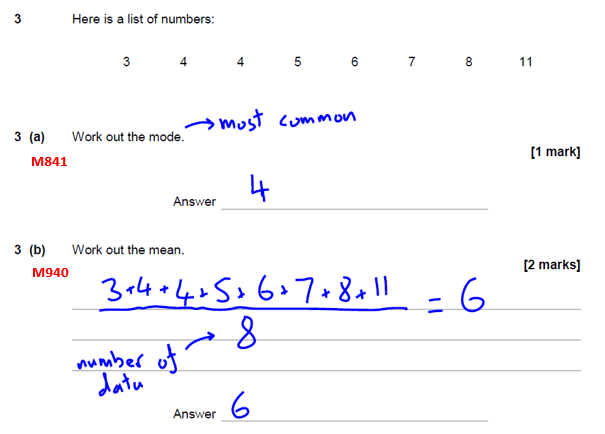
3. Give students model answers instead of mark schemes. Mark schemes are hard to read and interpret. As a department, creating model answer papers with hints or links to online resources (example below uses Sparx codes), will be of much more use than a hard to read mark scheme.
4. Teach students HOW to use a past paper, these are a precious resource and using them well is hard. Make sure they know that simply DOING a past paper is of little benefit if they don’t reflect on their strengths, learn from their mistakes, and act accordingly.
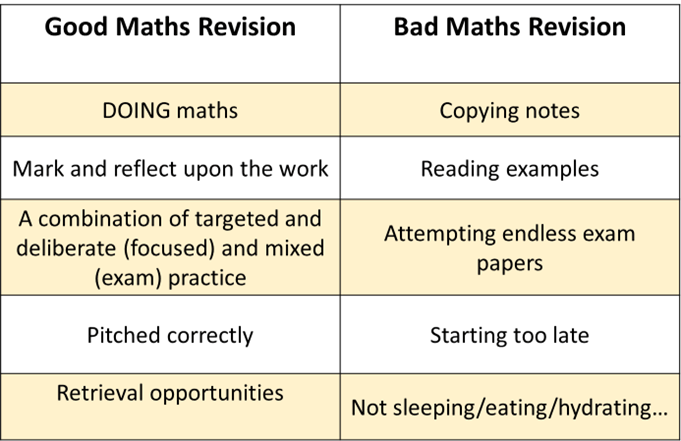
5. Teach students what good and bad revision looks like.
6. Remind students of the importance of sleeping, eating and creating a focused environment. This is all just as important as the task itself.
Any more to add? Please comment below.
I’m always interested in what people make of this so please feel free to comment with thoughts, questions or incomplete musings. Follow this or my Twitter account Teach_Solutions for similar content in the future. Also, check out the rest of this site, there’s some good stuff knocking about the place.
Feeding back to content in a lesson, when using means of mass participation (e.g. mini whiteboards) can be relatively straight forward. If you check the understanding of a tiny aspect of the curriculum, you can then respond accordingly depending on how the class have performing. This gets tricky when a lot has been assessed at once, like when a class sit a mock paper or an end of topic test.
When whole lessons are given over to feedback from an assessment there are some pitfalls we must make sure we don’t fall into.
Let’s go through things to avoid and then I will give a cycle that I believe works best in practice.
What not to do:
Avoid going through the entire paper – this will most likely not benefit anybody
Avoid having students mark their own work on big assessment pieces – it’s crucial that you know, not just how they performed, but exactly what gaps or misconceptions within a question/topics students have
Avoid going through the specific question in the paper and then giving students more of the same. There is an underlying root cause that would mean they performed poorly on a question. You need to identify that and address the cause, not the symptom.
Avoid giving every single student individualised written feedback. If students learnt well that way all we’d ever have to do would be give them a revision guide and tell them to read their way through the curriculum. This just won’t work.
Avoid giving students their papers back at the start of the lesson, you’re just making life harder for yourself.
What to do
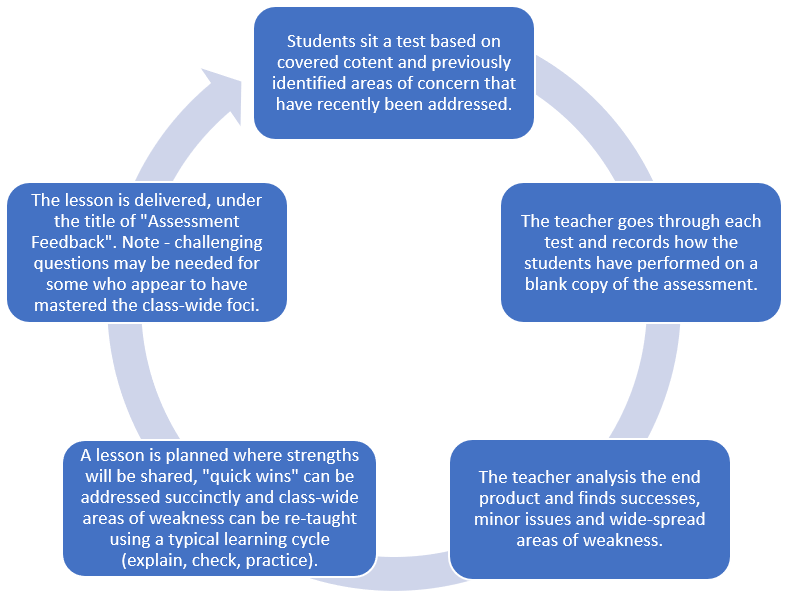
When marking the papers have a blank copy of the assessment to hand or some sort of summary sheet. Use it to record common misconceptions, gaps and strengths. Tally how often these occur so you start to build a picture of things that need working on. If using a QLA, this could be done with a selection of student papers once the QLA tells you exactly where to focus your efforts.
From the weaker areas split these into 3 categories:
Quick Wins: topics which may not have negatively affected all of the class but which can be addressed through little and often retrieval practice
Highest Leverage: these are the handful of topics that most students could benefit from reteach from and will make up the main focus of the lesson
Another Day: these topics are either too complex or require multiple areas to be addressed before students can access it meaningfully. If time permits at the end of the course or at another suitable point, these can be addressed then
Plan the lesson. Ensure that the key concepts missing from the highest leverage topics are retaught. You do not need to go through the exact exam question, zoom out and address the topic holistically. Use mini whiteboards to check for understanding and be responsive once the idea has been retaught and then give students time to practice and embed the new learning.
Have suitably challenging versions of this topic ready for those students who got it correct first time around but know that there is no harm in them revisiting this concept with the rest of the class.
All of the above can be broadly summed up in the following diagram:
Remember:
You will not be able to fix every gap. It is better to go through a few things well than many things poorly.
When reteaching, you should follow the same principles as when normally teaching (model, check, practice).
I hope this is of some use. This post seems to fit nicely with two others. This one, all about making sure that the marking you do is accurate in the first place. And this one, all about making the best use of QLAs.
I’m always interested in what people make of this so please feel free to comment with thoughts, questions or incomplete musings. Follow this or my Twitter account Teach_Solutions for similar content in the future. Also, check out the rest of this site, there’s some good stuff knocking about the place.

















 Teach Solutions