Feeding back to content in a lesson, when using means of mass participation (e.g. mini whiteboards) can be relatively straight forward. If you check the understanding of a tiny aspect of the curriculum, you can then respond accordingly depending on how the class have performing. This gets tricky when a lot has been assessed at once, like when a class sit a mock paper or an end of topic test.

When whole lessons are given over to feedback from an assessment there are some pitfalls we must make sure we don’t fall into.
Let’s go through things to avoid and then I will give a cycle that I believe works best in practice.
What not to do:
- Avoid going through the entire paper – this will most likely not benefit anybody
- Avoid having students mark their own work on big assessment pieces – it’s crucial that you know, not just how they performed, but exactly what gaps or misconceptions within a question/topics students have
- Avoid going through the specific question in the paper and then giving students more of the same. There is an underlying root cause that would mean they performed poorly on a question. You need to identify that and address the cause, not the symptom.
- Avoid giving every single student individualised written feedback. If students learnt well that way all we’d ever have to do would be give them a revision guide and tell them to read their way through the curriculum. This just won’t work.
- Avoid giving students their papers back at the start of the lesson, you’re just making life harder for yourself.
What to do
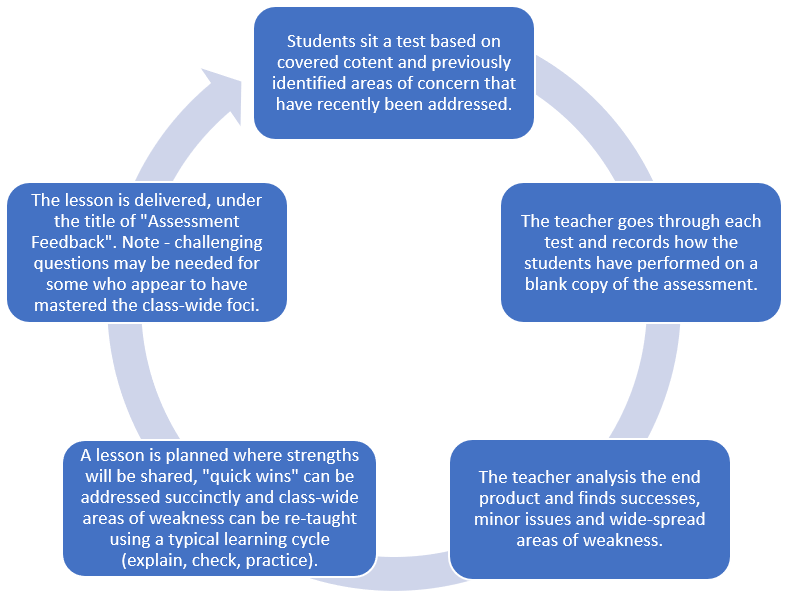
- When marking the papers have a blank copy of the assessment to hand or some sort of summary sheet. Use it to record common misconceptions, gaps and strengths. Tally how often these occur so you start to build a picture of things that need working on. If using a QLA, this could be done with a selection of student papers once the QLA tells you exactly where to focus your efforts.
- From the weaker areas split these into 3 categories:
- Quick Wins: topics which may not have negatively affected all of the class but which can be addressed through little and often retrieval practice
- Highest Leverage: these are the handful of topics that most students could benefit from reteach from and will make up the main focus of the lesson
- Another Day: these topics are either too complex or require multiple areas to be addressed before students can access it meaningfully. If time permits at the end of the course or at another suitable point, these can be addressed then
- Plan the lesson. Ensure that the key concepts missing from the highest leverage topics are retaught. You do not need to go through the exact exam question, zoom out and address the topic holistically. Use mini whiteboards to check for understanding and be responsive once the idea has been retaught and then give students time to practice and embed the new learning.
- Have suitably challenging versions of this topic ready for those students who got it correct first time around but know that there is no harm in them revisiting this concept with the rest of the class.
All of the above can be broadly summed up in the following diagram:
Remember:
- You will not be able to fix every gap. It is better to go through a few things well than many things poorly.
- When reteaching, you should follow the same principles as when normally teaching (model, check, practice).
I hope this is of some use. This post seems to fit nicely with two others. This one, all about making sure that the marking you do is accurate in the first place. And this one, all about making the best use of QLAs.
I’m always interested in what people make of this so please feel free to comment with thoughts, questions or incomplete musings. Follow this or my Twitter account Teach_Solutions for similar content in the future. Also, check out the rest of this site, there’s some good stuff knocking about the place.
 Teach Solutions
This, like your other articles, is a well thought out and useful post, thank you!
LikeLike
Thank you. So kind of you to take the time to say so. Glad they are of use!
LikeLike