Building the Right Culture

Cultures exists in a school. The only choice you have is whether you proactively want to define and shape it or whether you want to leave it up to chance.

A culture existing in a school is an inevitable byproduct of people working together. One will be created, there is nothing that can be done about that. As a result, it is essential to define the culture you want and then explicitly put things into action which make it a reality for all. Without taking a proactive stance on this, the door is open to producing unwanted working environments. This blog considers practical ways in which a desirable culture might be made.

Defining Culture

“Every teacher needs to improve, not because they are not good enough, but because they can be even better” Dylan Wiliam

The culture we want to create in each of our schools is one where teachers feel like they can develop and grow in a safe and nurturing environment where they can open-up about concerns safely. They are honest givers and open receivers of feedback.

Creating Culture

“To change your company’s culture, don’t start by trying to change the culture… Culture gets changed by doing real work in line with the new strategy” Michael Beer

Talking the talk is not enough, great culture relies on schools having the systems in place which change how things are done.

1.    We do what we say we do

Make sure that initiatives and systems are not just spoken about but enacted. If teaching staff should be adhering to something, then all leaders should be modelling this too, including ways of working, implementing new teaching strategies, and being coached. All should be happening visibly and unashamedly at every level.

2.    Provide feedback opportunities

Calendar set times where feedback will be gathered from stakeholders (pupils, staff, and parents). Make these explicit, anonymous, and put time aside to listen and learn from the responses to help produce inclusive working habits. Not only does this provide a chance to improve, but it also models the humility that great leadership requires.

3.    Be wary of initiative overload

There is a difference between being in a state of continuous improvement and continually changing things. Putting the time aside to get the foundations right in the first place should mean that only tweaks are needed to refine processes. A culture of too much change too quickly can overload staff and create a feeling of unease and of being “lost at sea”. New or improved ideas should, where possible, find ways to be assimilated into normal practice and, where completely novel ways of working need introducing, it is worth considering what they are replacing and making that explicit to stakeholders.

4.    Share the big picture

Where appropriate, tying in CPD and new initiatives to the broader vision and direction of the school is key. Leaders are often very close to the “why” behind a lot of initiatives but may skip this step when delivering the “what” to staff. Framing the micro in terms of the macro goes some way to alleviating this. Alongside this, any opportunities to keep the school’s vision at the forefront of people’s minds (posters, email signatures, letter headers) are always beneficial.

5.    Build a sense of belonging

Having a language or actions that make a school unique can help build a sense of belonging. From ways to show appreciation to using British Sign Language as a means of non-verbal communication with all staff, schools can build unique practices that set them apart. Rather than being alienating, the uniqueness is something that can bring people closer together.

6.    Appreciating the working habits of others

Being aware and allowing for different people’s working habits is crucial to them feeling seen and respected. Consider two people. One is someone who needs a time-pressure to get work done and will happily work into the night. The other doesn’t like working under pressure and has responsibilities outside of work so needs to be done by 5pm every day. If deadlines are met and the quality is there, there is nothing wrong with either of these two working habits. It’s important, as leaders that we provide tasks with enough time and clarity that all our colleagues’ habits can be respected. The same can be said for communication habits. It is worth considering if there are specific modes or times you want communication in your school to happen.

7.    Be upfront from day one

Letting staff know in recruitment and induction processes the ways of working at the school is not only a kind thing to do, but it also helps establish the cultural norms you expect to see early on. The fewer surprises the better. If everything that your school does is for the good for the children served, then there is nothing that needs to be hidden. Spelling out how colleagues will need to be working and what is expected of them at the earliest opportunity ensure people entering the organisation do so knowingly and willingly. Better to have someone decide the school is not for them on an interview day than turn up and be a negative force in what will most likely be a rather short-lived time with you.

8.    Be inclusive

Be aware that everyone has their own personal culture or requirements they bring to your school. Something which should be considered and respected. The current list of protected characteristics in the UK are age, disability, gender reassignment, marriage and civil partnership, pregnancy and maternity, race, religion or belief, sex, and sexual orientation. Proactively ensuring that none of these are a barrier to staff working or socialising at school-organised events is not only crucial for culture, but a legal requirement.

9.    Be consistent

Do all the above and do it consistently every day. Culture is not something that is built in a day or something that only needs considering on “Doughnut Fridays”. When done right, a school’s culture is lived out daily through the systems, processes and working habits that have been put in place.

Reflect

  • How do you define culture in your school?
  • What mechanisms are in place to ensure culture is purposefully built over time?
  • How do you ensure all staff feel they are a part of the school culture?
  • How do you ensure pupils and parents/carers feel like they’re a part of the school culture?

Buying Coconut Oil Didn’t Give Me A Six-Pack

A cautionary tale about not taking the easy option in education if you want to truly transform practice

I’ll start with a personal story from a few years back but will then quickly make the link to the world of education and the key point I want to get across in this post (the story is short and connected, I promise).

The Story

When I lived in London I had a flatmate who was in great physical shape. Proper front cover of magazine vibes. She was in the sort of shape I always wished I’d been in. She had converted the garage into a gym and used it on a near daily basis. She cycled to work. She rarely drank alcohol. She cooked EVERY meal from scratch. She used coconut oil instead of olive oil. She got a good amount of sleep. She had a relatively low stress job and a great work-life balance.

I envied her and living with her inspired me to get into the sort of shape I hadn’t achieved so far in life. So here’s what I did… I bought some coconut oil.

That’s it. Of that list of things she was doing that helped her reach her goal I copied only that. It’ll be of little surprise for you to find out that years later I’m still after that classic beach-bod. What’s maybe more sad, is that I still haven’t even finished the jar of coconut oil yet.

The Point

Visiting other schools is often incredible CPD and when you see something in action that blows you away it can make you feel both envious and inspired.

Going out there and visiting great schools knowing in advance that they have overcome hurdles you face currently or that have successfully implemented something that you want to embed is a great thing to do. The level of focus and specificity of the visit will most likely lead to focused and purposeful conversations.

Visiting schools that are getting great results can be great CPD too. These may be less focused visits but can be equally valuable. The chance to visit and try and find out what they are doing that is working well, what ideas you can take back, what processes you can steal is more often than not, worthwhile. These less-focused visits need to come with a health-warning though.

A few years ago when Michaela Community School was all the rage and on track to be one of the top-performing schools for progress in the country they attracted a lot of visitors. Of all the things they were doing, one seemed to become the new “must-have” in schools almost overnight. The knowledge organiser. These now take so many different forms its hard to even define what one is any more. They’re also something that Michaela distanced themselves from after reviewing their effectiveness. Alas though, the damage was done. The knowledge organiser was the equivalent of my flatmate’s coconut oil. It was the easiest thing to replicate and people thought it would drive results up in their own settings. Like my six-pack however, in most institutions there is still a lot left to be desired.

I want to outline ideas I’m seeing as the next “knowledge organiser”. Ideas or buzzwords that may feel small and easily replicated which are being held up as a panacea to all of education’s woes but in reality aren’t much more than superficial decoration or are systems which need a monumental amount of thought and consideration before being rolled out effectively in a school.

Beware The Next Knowledge Organiser

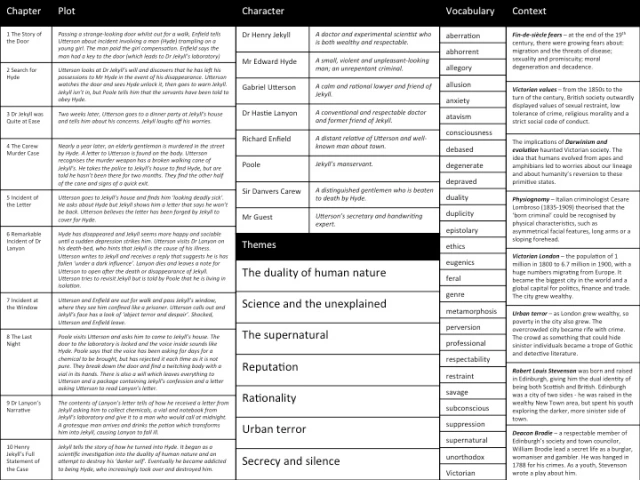
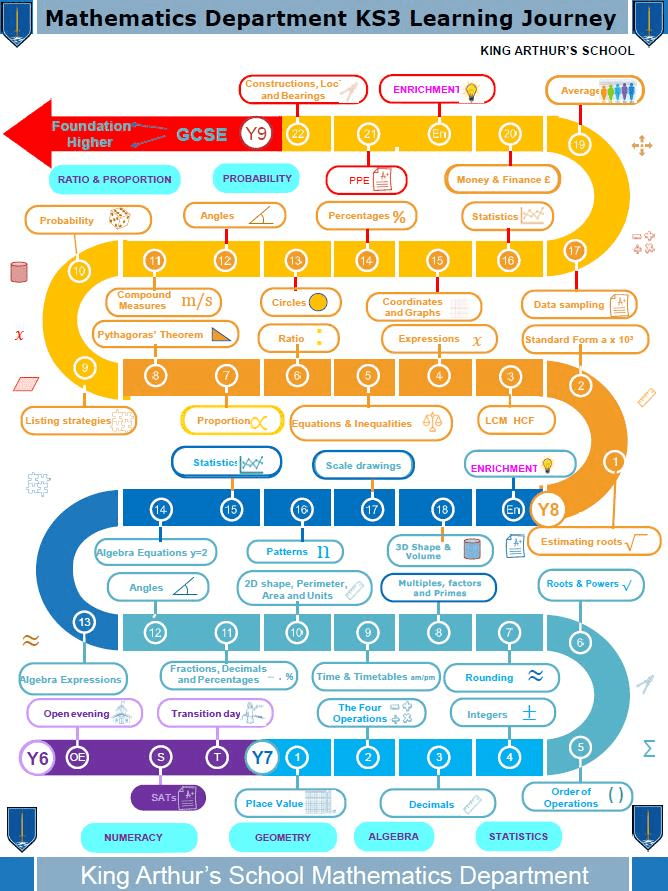
Visual Curriculum Maps: Have you seen these yet? These spiral journeys colourfully map out a student’s path through a subject . If you haven’t, you can pay a few quid to download some from TES. They worry me though. Who are these benefiting and how? The amount of time put into creating a document which will not be referred to or of use throughout an academic year baffles me. I won’t even start on how demoralising it may be for a student entering Y7 without a grasp of the basics to get to Y9 and find out they are years “behind” according to this flightpath! Still, at least they look pretty.

Mini Whiteboards: I LOVE MWBs. They are, in my opinion, a necessary, but not sufficient, element of effective teaching. They are the quickest and easiest way I’ve seen of engaging a class full of students in deep and accountable thinking. HOW they are used though is vital. There is no point collecting all that data and doing nothing with it. The active ingredient of what makes MWBs so effective can so often be missed and it breaks my heart when I see it. I think we should be talking less about mini whiteboards and more about responsive teaching and means of mass participation. THEY are the active ingredients, not the piece of plastic.

Instructional Coaching: Hard to find a bigger buzzword at the moment. Don’t get me wrong, I think it’s incredible. But the amount of care and attention that needs to go alongside successful implementation of this is immense. If a school thinks that it’s implementing Instructional Coaching overnight then what it’s implementing is not Instructional Coaching.

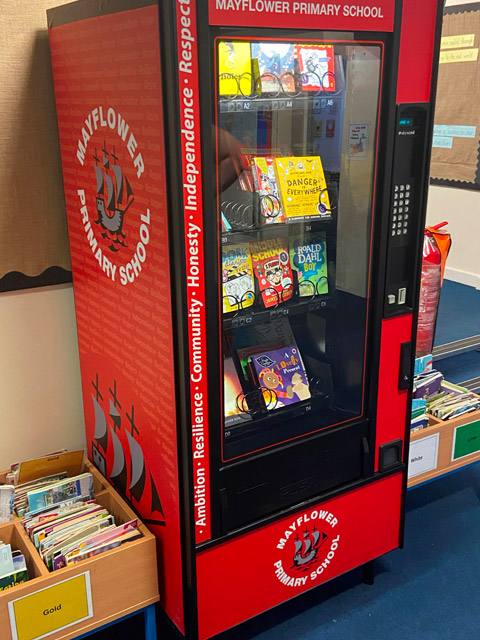
Book Vending Machines: These are a little old now and I wonder if they are still as fully stocked and shiny as they once were on Twitter so long ago. If the money spent on them was spent on actual books and if a love of reading was built intrinsically, rather than extrinsically, maybe we’d be in a better place.

No Marking Policy: The amount of pointless time-consuming marking I’m supposed to have done in my time makes the idea of not marking anything appealing. There is a balance though and there are some things only an expert looking at a piece of student work can tell. Beware blanket policies!

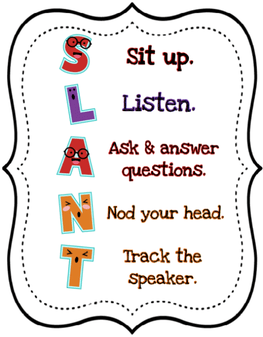
SLANT: Using SLANT does not make you good or evil. It doesn’t give you a calm classroom either. The culture and delivery around any behaviour management system is crucial. Two classrooms that use SLANT can be as different as any two other classrooms in the world. We need to stop over-simplifying complex ideas in education, and we need to do so quickly (with a straight back and empty hands if possible).

Takeaways

It is important to remember that it is never just one thing that makes an education transformative. It is always a team effort and it is definitely a complicated task. If you think you’ve found something that you can install overnight which will make a seismic difference I suggest you think twice before rolling out a potentially short-lived and ineffective strategy.

If you find yourself seeing a new idea or visiting a school getting incredible results and you’re not sure how they are doing it ask yourself or staff working there some questions.

Questions for them:

  • What do you attribute your success to?
  • What did the implementation of this look like?
  • How long did you take for you to be happy with it?
  • What lessons did you learn along the way?
  • If you were to start again, what would you definitely keep?

Questions for you:

  • What do I hope to achieve by implementing this? How will I know it’s worked?
  • Is this the highest leverage use of my time?
  • Will this still be working in two years time?
  • What will the impact on students be?
  • How will I make sure it is embedded?
  • Do staff have time and capacity to do this well?

The New Year Fallacy

Creating the right climate at the start of the year is tricky enough. What can feel impossible, is changing it part way through the year. This piece suggests some ways to go about it.

Introduction

Sometimes I have the privilege of coaching teachers. Currently, I’m never in one place long enough to do it on a sustained basis but hope that I can be of some use alongside a more structured programme. There was a member of staff last academic year who I dropped in on semi-regularly and I ended up giving her the same action steps after each visit. Because of this I tried giving it in different ways over time to see if that made any difference. It never did. I found out her university tutor and her mentor were all giving her the same feedback too.

Her planning and delivery was great but lessons kept being being derailed by the same few students. The school had a clear behaviour policy involving a warning and then dismissal from the class but she wasn’t using it. She agreed with the action step (the use the policy), she observed others using the policy and she observed me, with her class, using the policy too and we scripted and rehearsed the delivery of sanctions to students. None of it seemed to work. This lasted all year.

I visited the school a few months into a this academic year expecting to see the same issue again. I did not. Instead her classrooms where a haven. All that great planning and delivery was landing to every student and her room was the epitome of calm.

What was it that had changed? I caught up with her recently and asked what it was. Some missing piece of advice? Some quality CPD she’d received? Something else? I was wondering what it was that I had done wrong.

She said “I needed the fresh start, I knew what I should have been doing, but because of how those kids from last year saw me, I was never able to change what I did, I know they knew I wasn’t that person. I needed new classes”.

This really resonated. I remember the anxiety at the start of the year trying to ensure behaviour is perfect. I also remember, probably 2 weeks into teaching sometimes, that I’d now lost this class forever and that I’d have to wait another year before I try again. It didn’t take long before I would write off ever being able to get a class back to where I wanted them.

This teacher managed in 1 year what took me about 8 and should be applauded. This post is challenging the narrative that we need to wait until the start of a new year and suggests ways that you can turn around culture in the classroom at any time of year, in a matter of weeks.

This post is broken down into things to do before that first lesson where you want to instigate change, during it, and then after. But first, there is a mindset issue that needs addressing.

Challenging a Fixed Mindset

Now, none of the tips we’ll explore below would actually have helped the teacher I referenced if their mindset wasn’t different in the first place. She was given a lot of these tips, though not all at once and it had no impact. The idea of enacting one small change at a time maybe wasn’t appropriate in hindsight and a full strategy was needed for her to see the change that was possible with a class halfway through the year.

What I do know is that it’s never too late to create the culture you want in the classroom. It takes a bit of time and a bit of prep but, I believe within 4 lessons, you are able to transform any classroom into the culture that you want it to be. If it takes longer, that’s no bad thing, if it take less time, fair play to you.

It’s important to remember a few things about human beings whilst you read the below:

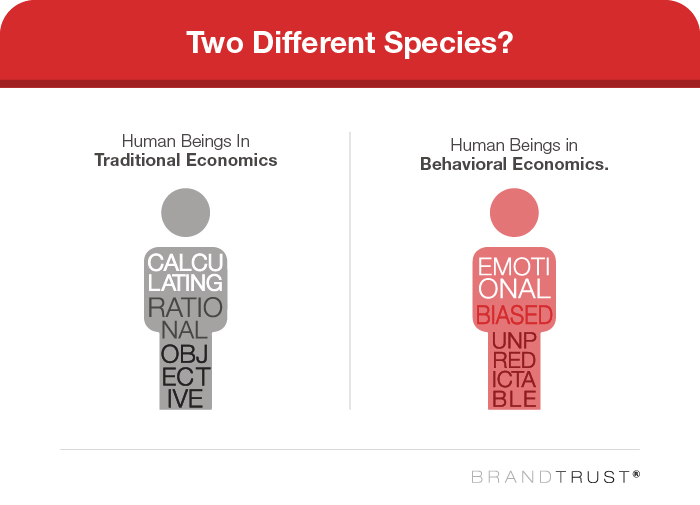
  • We Want to Fit In – We are social animals who want to fit in, we will adopt the perceived norms of the group almost unconsciously. Spotlight the good behaviours you want to see and others will fall in line. Highlight the 25 students not talking, rather than the 5 that are. If a disruptive minority get the majority of attention it will skew perceptions of how to act. Even if it means making up positive behaviours that you cannot quite see e.g. “I am only waiting for 3 students now to be silent” even when you know 10 are talking can work wonders.
  • Recency Bias – We are fickle when it comes to memory and are biased towards what has happened recently. This is great when you want to instigate change as 3 good lessons can outweigh 20 poor ones from the past. Knowing this can help reassure you that no matter how many lessons have gone wrong in the past, there is no time like the present to change this.
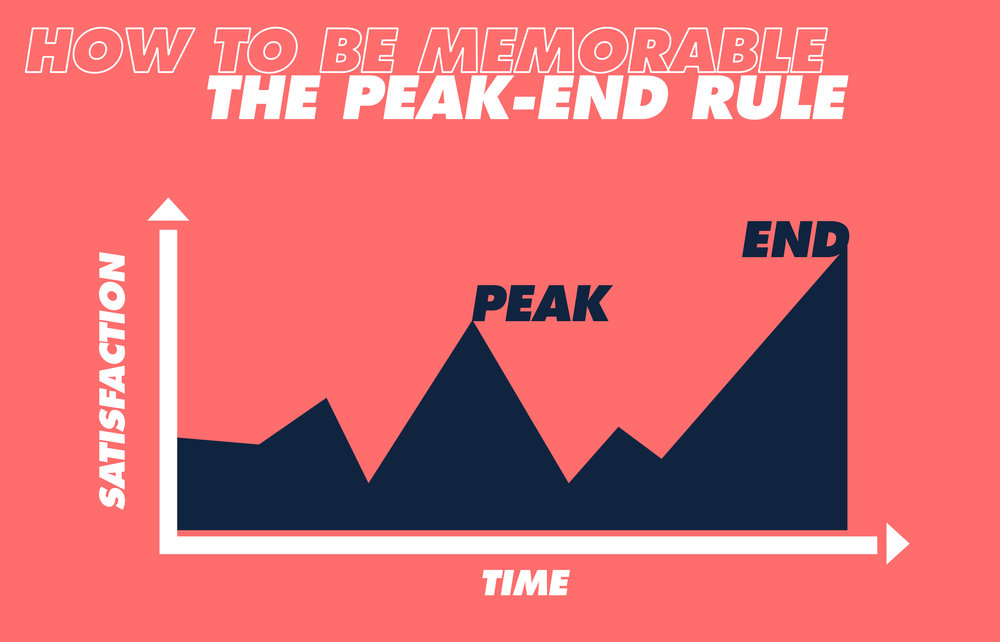
  • Utilise the Peak-End Rule – We don’t remember events that well. The end of an event and the emotional high of it are the two moments that “stick” the most. Trying to create a moment of joy in the lesson and ensuring you end positively, no matter how the lesson actually went, can work to your advantage. Students can end up having a misplaced sense of what norms are in your classroom if you focus on these two things.

All the ideas above are from behavioural economics. In my opinion this is an unused field in the world of education – read more about that here

On top of all the above about humans in general, it’s worth remembering that, as students, they want to learn. They want to do well. They want to succeed. This doesn’t stop them doing things in the short-term to self-sabotage but, they want you to do well. To lead them. To hold the line. And, having been trusted with the responsibility of educating them, you owe them all that.

Preparation

  1. Ensure Content Isn’t a Barrier – Plan lessons where the content is definitely not going to be a barrier to success. If this means pausing how ambitious the curriculum is temporarily, then so be it. It will be worth it in the long run and you need to be sure in the lesson that students are able to access the content you put in front of them.
  2. Tell Someone – Let someone know you are doing this, a mentor, HoD or SLT. Where possible, have them get “on-call” or someone in charge of behaviour to be nearby ready to quickly whip anyway any students not playing along.
  3. Set Boundaries – Map out the expectations you want from students at each point of the lesson. When should there be silence? When should they be participating? What does participation look like? Rehearse making these expectations explicit to students before each phase of the lesson. I’d advise making things very black and white to begin with. Group work and paired talk is harder to manage so silence or one person talking at a time is your friend here.
  4. Practise – Rehearse giving short, non-personal warnings and reminders that do not require a student response.

During the Lesson

  1. Praise – Praise, praise, praise! Whilst it’s understandable you’re going to be on edge, a lot of behaviour management is preventative and if you want to establish new norms of working in your classroom you need to spotlight these where they exist. Praising the good as early and as often as you can is vital. You want to create a room where doing the right thing brings attention, not the opposite.
  2. Minute 0 – Be ready to hold the line from the first second, and to hold it on the smallest of things (untucked shirts, top buttons…). This can feel harsh but is necessary. The students can rise to the challenge and you need the catch the first student choosing not to meet this as soon as you can.
  3. Stay Calm – Keep your cool and do not get drawn into long arguments. 3 warnings that lead to a dismissal could be as simple as “I asked you to tuck your shirt in, it’s now a warning”, “that’s not how we respond to sanctions here, that’s your final warning”, “it’s rude to talk over someone, you now need to leave my class”.
  4. Check for Understanding – Use mini whiteboards to check every students’ understanding. Break those checks down to be accessible and matched perfectly to the independent task. This means you can let them work, safe in the knowledge that they can access the content. They do not need to be talking to their friend or asking anyone except you for help.
  5. Stand Still – Sacrifice circulating for observing everyone. If there is a chance to walk around the room where you need to inevitably have your back to certain parts of the room, do not do this until you are absolutely certain you have the culture you want.
  6. End on a High – End the lesson piling the praise on. No matter how much stuff happened during the lesson you did not want, there will be plenty that was fine. Leave the students with that in their mind, it’ll be their last memory of you and that lesson before the next one.

After the Lesson

  1. Call Home – Phone home for students with a 3:1 ratio of positive to corrective messages. This is likely not sustainable in the long run but only needs to happen for the first week or so.
  2. Check in –Catch students on an individual basis, with a head of year or form tutor if necessary, that did not act how you want and spell out very clearly, what you expect to see of them next time.
  3. Reflect – Reflect on what happened. Was the content accessible enough? What lead to a “back and forth” with a student? Was the line held high enough at the start?
  4. Go again – Do not drop your expectations of these students. Managing the behaviour of 30 adolescents is a never ending job but a 2-week blitz sure can make things a lot easier.

Good luck!

I’m always interested in what people make of this so please feel free to comment with thoughts, questions or incomplete musings. Follow this or my Twitter account Teach_Solutions for similar content in the future.

Teaching Problem Solving (Kind Of)

Students don’t get better at problem solving by simply solving more problems. This is a look at what sorts of problems need solving in school mathematics and some explicit strategies that can help make our students better at it.

This weekend I had the pleasure of talking at my first #MathsConf. I spoke about how I approach teaching students how to become better problem solvers. This is a breakdown of that talk and includes the PowerPoint that was used at the end for download. This topic definitely warrants further exploration in the future but here is most of what was discussed.

Defining Problem Solving

It’s vital that we define problem solving if we’re going to talk about problem solving strategies.

There are many different types of problems that need overcoming. These vary from solving the climate crisis, how to organise one’s time to produce the perfect Christmas dinner, solving Fermat’s Last Theorem to counting how many squares there are in a diagram.

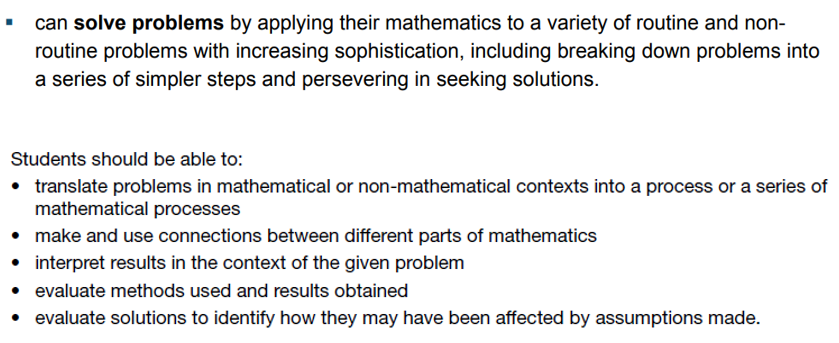
These are undeniably problems that need solving and may have strategies that are useful to employ when attempting to answer them. They do not, however, represent the sort of problem solving students need to perform well in a KS2-KS5 terminal exam. Luckily, the National Curriculum defines exactly the sorts of skills that are needed.

Unfortunately though, these are about as open to interpretation as sentences go. At KS4 these are referred to as AO3 (Assessment Objective 3). It is possible to search on an exam board’s bank of questions for where this objective has been assessed in the past. Doing so yields examples like these:

Some, like the nested triangles and multi-step circle theorem questions, may look familiar and people are sometimes surprised to know that these even count as “problem solving” questions. That’s good news though. It shows that the types of questions that assess a student’s ability to problem solve can be quite narrow and predictable. Because of that, it makes the skills needed to succeed with them teachable.

There will be students that can access these questions without any extra help. That can make it tempting to assume all students should be able to do this. This is not the case however and, much like it would be our job to fix any gaps in a student’s times tables knowledge for example, it is also our job to equip them with any skills they are missing out on compared to their peers. If we ever want to close the attainment gap in this country we need to ensure that all the implicit skills the more advantaged students have are distilled and taught to the others.

The Goldilocks Zone

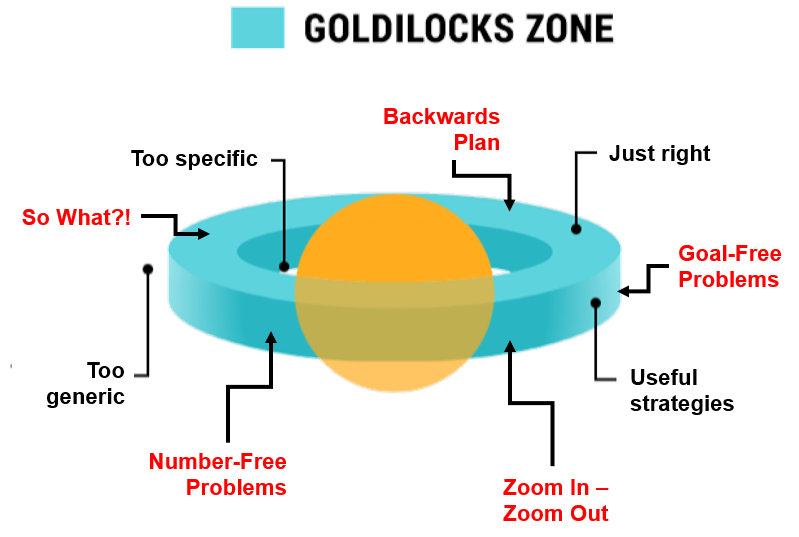
So what are these skills? Well, they need to be specific enough to be explicitly taught. They also need to be generic enough to be useful in a variety of situations. They need to be “just right”.

There are a few labelled in the diagram, some may look familiar, others should not (I made them up). I will discuss “Zoom In – Zoom Out” and “Number-Free Problems” below. But first…

Embedding Problem Solving into the Curriculum

These strategies, once distilled, need to be interleaved throughout the curriculum. They need to be introduced at an appropriate stage and then included in any retrieval activities, codified and shared across a department, and referred to throughout a student’s time in their school. They are not to be left until the last 2 weeks of Year 11, nor are they something to be talked about once and then forgotten. That doesn’t work for teaching anything else and it won’t work for this either.

The Strategies

Number-Free Problems

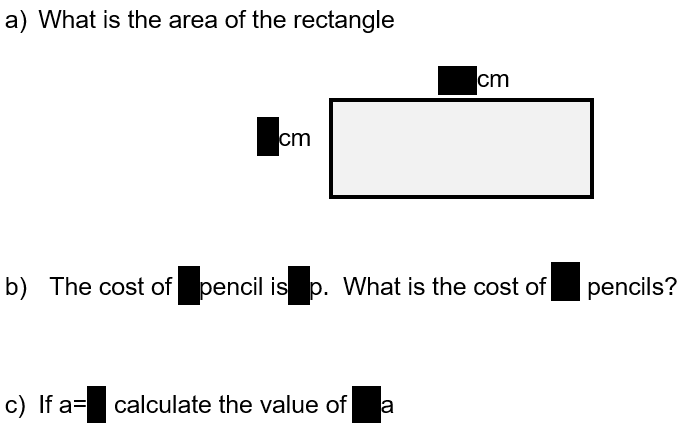
The first idea is to encourage students to ignore the numbers when they first read a question.

I’d argue that most people fluent with the idea of area, proportion, and substitution would confidently be able to say they can solve these questions. There’s obviously an important factor missing here, but the numbers are not a crucial part of the formulation of the problem, just of the almost arbitrary calculating of the solution.

The human brain can hold about 7 things in its working memory at any one time. If you focus on the surface details, in this case the numbers, then you are taking up valuable space. It doesn’t matter so much with the low-complexity level of the questions above but what about this one:

Trying to solve this, whilst caring about the 10 numbers on show is very tricky. Ignore the numbers of this “problem solving” question however and, I think, it becomes easier. My argument is that those students who successfully answer questions like this are already doing this strategy. We just need to make the implicit explicit. It forces students to engage with the deep structure of the problem to produce a plan like below:

They cannot get carried away with the numbers and just randomly try adding or multiplying the first few values they see. Here it is with another problem:

These are KS4 questions but this strategy can be applicable to KS2-KS5 content. Equipping students with the strategy of ignoring the numbers and producing a written plan for those big mark questions feels like a positive step towards closing the gap. Teaching this to students early on and referring to the strategy throughout their schooling could be immensely powerful.

Zoom In – Zoom Out

This strategy is more suitable to geometry questions. Again, I think this is something a lot of people do automatically, and its something we should be explicitly teaching all students.

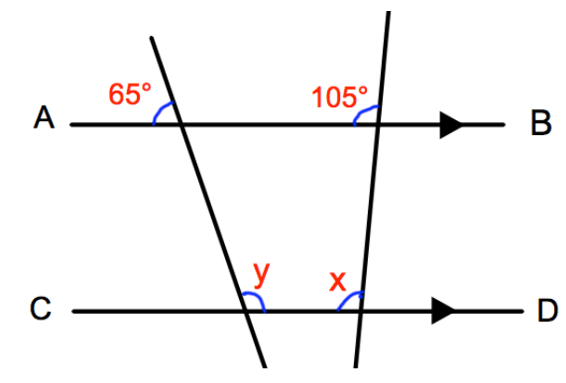
The idea is to ignore certain parts of a diagram at any one time and focus in on what it is that’s needed. If asked to find x in the diagram below it could be overwhelming.

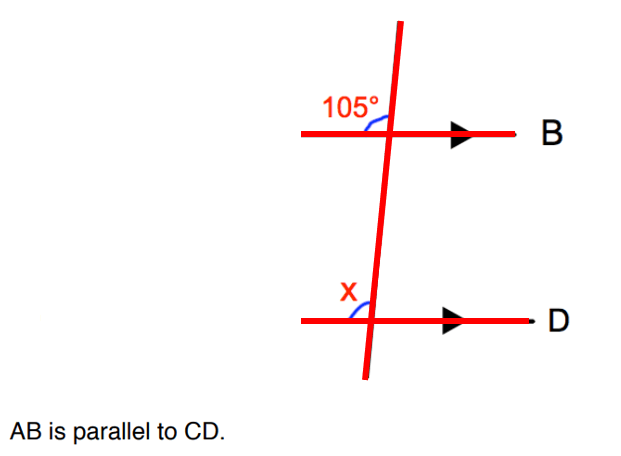
Once you’ve isolate the 2 lines that make x and the other parallel line though you are left with:

I think this is the sort of mental “zooming in and zooming out” that successful problem solvers are doing. Making this clear to students and giving them time to practice it feels purposeful.

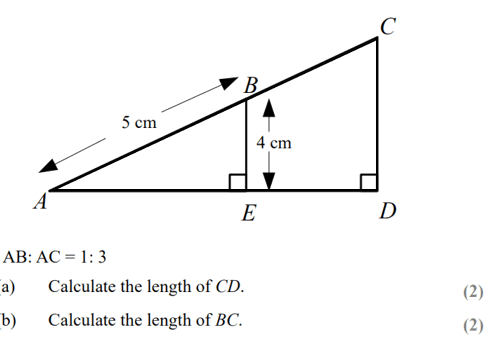
Making it clear with this question:

That it is useful to either mentally or physically have this image in your head:

In Summary

I think there are a set of explicit, teachable, skills we can pass onto students in order for them to better access the AO3 or “problem solving” marks available to them. This involves distilling the things that experts do implicitly, automatically, and turning them into named strategies that are embedded throughout a curriculum.

My thanks to you for reading this, to MathsConf for letting me talk about this, and to the audience for choosing and then engaging with the session. Please find the PPT that was used for the session below.

I also spoke about this for Tip#1 in Craig Barton’s Tips for Teachers podcast if you want to hear parts of it again (along with 4 other topics) https://tipsforteachers.co.uk/craig-latimir/

I’m always interested in what people make of this so please feel free to comment with thoughts, questions or incomplete musings. Follow this or my Twitter account Teach_Solutions for similar content in the future.

Behavioural Economics – An Untapped Goldmine for Education?

An exploration of what behavioural economics may be able to offer education; not in contrast to cognitive science, but complimentary to it.

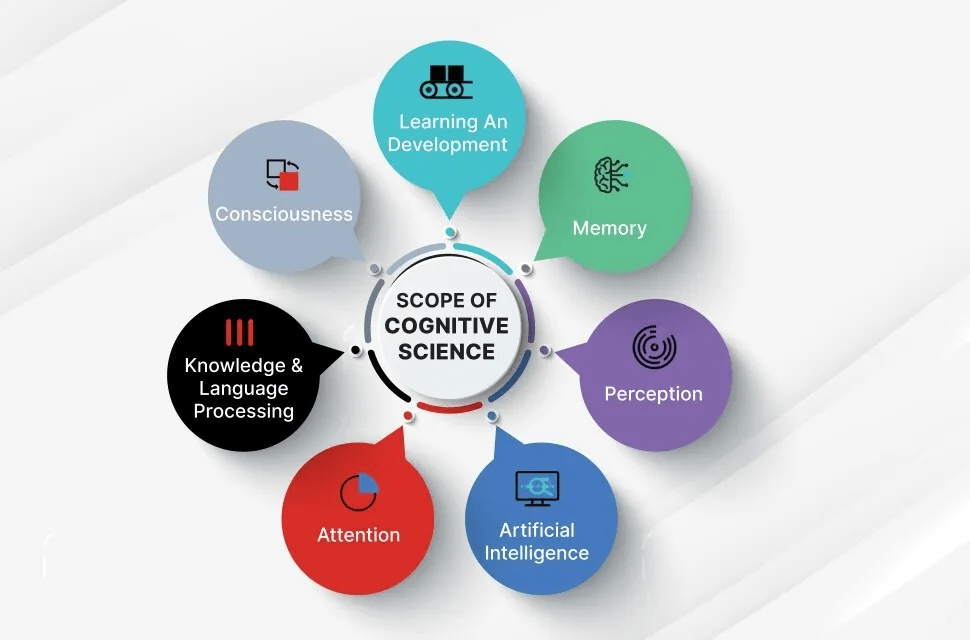
No one quite knows when it started, but for a while now cognitive science has been ever-present in discussions around best teaching practice. If you accept learning to be a change in long-term memory (which even if you don’t it’s hard to argue that it doesn’t have a vital role to play) then all of a sudden this huge bank of research looking into memory and how that part of the brain works is useful.

This blog warns about the dangers of treating cognitive science as a “catch-all” for teaching and asks if there is another domain out there, an unexplored goldmine, ready to shed light on some pedagogical aspects that cognitive science does not cover.

Power of a Shared Language

Ideas around retrieval practice, interleaving, interweaving, dual-coding, explicit instruction, schema, cognitive load… all originate in the realm of cognitive science. These are all great things which have had a huge benefit on education recently for many reasons, not least because simply having a shared language is a powerful thing.

All the ideas above have been written about A LOT. The power of a shared language has allowed teachers that did those things anyway to talk about them more succinctly. It allowed a community to experiment, tweak and innovate all these ideas and apply them to the classroom in the knowledge they were all working on the same thing. It allowed people to codify aspects of teaching and break it down into discrete parts that allow it to be explicitly taught. The ability to talk about an idea without having to show someone it is a powerful thing.

Cognitive Science – Necessary but not Sufficient

Cognitive science is not a panacea, it focuses very inwardly on the processes of the brain. By and large, its studies of how learning happens are done in isolation, in a lab. It misses out a massive part of the realities of teaching, namely, that most of the time it happens in a room full of not 1 but 30 brains. Each of those is living inside messy, illogical, hormonal, confused, unique, incredible, frustrating, funny, brave, unpredictable, bored, inspirational, exhausted humans.

Cognitive science does not exhaustively cover what it takes to be a teacher – not even close; in its defence it has never claimed to, but I do worry about increasingly seeing teaching practice becoming synonymous with cognitive science.

It is a necessary but not sufficient component of education. Its effects will only work if all your pupils are motivated to engage with the content in the first place. That sounds simple enough but behavioural issues are often the biggest barrier teachers face in their delivery of content. No matter how well you know their brain should work in theory, if you can’t get them to engage with the content in the first place it will be, inevitably, ineffective.

Some Unanswered Questions

Some examples of common issues teachers have that cognitive science cannot solve are:

  • why do they make silly mistakes when they actually know the answer?
  • why don’t students try their hardest on a test despite wanting to do well?
  • why don’t they revise when they know it is good for them?
  • how do I win a class back that I feel I’ve lost?
  • how should I end my lesson?
  • how do I get them to behave?
  • how do I get them to do their homework?
  • why do they make bad choices despite seemingly wanting to learn?
  • how do I get them to work on a wet and windy Wednesday?

So does it exist? Is there something which has been studied for decades which contains the tools, tips, and shared language we need to tackle things like the questions above? Something which could be the starting point of a new shared language which could codify and share some of the great practice that already exists? Well, I think it does.

Behavioural Economics

Cognitive science is to learning as behavioural economics may be to behaviour for learning. If you think there isn’t as much or more to be gleaned from behavioural economics than there is from cognitive science then let me try and convince you with the below.

As you go through these, see if they resonate with problems you have experienced. Imagine there being as many books written about their application to education as there are for cognitive science. Imagine having a shared language so people can talk the same language around these things, develop strategies on the same issue, talk concisely to each other about known problems. Imagine these ideas being researched to see what effect there is on learning. Then imagine the power that could have on the educational landscape.

I’m going to introduce 8 ideas, explain them, and discuss implications they could have in the classroom. This is just the tip of the iceberg though. Both in terms of the concepts out there and how the ones mentioned could be used for by schools.

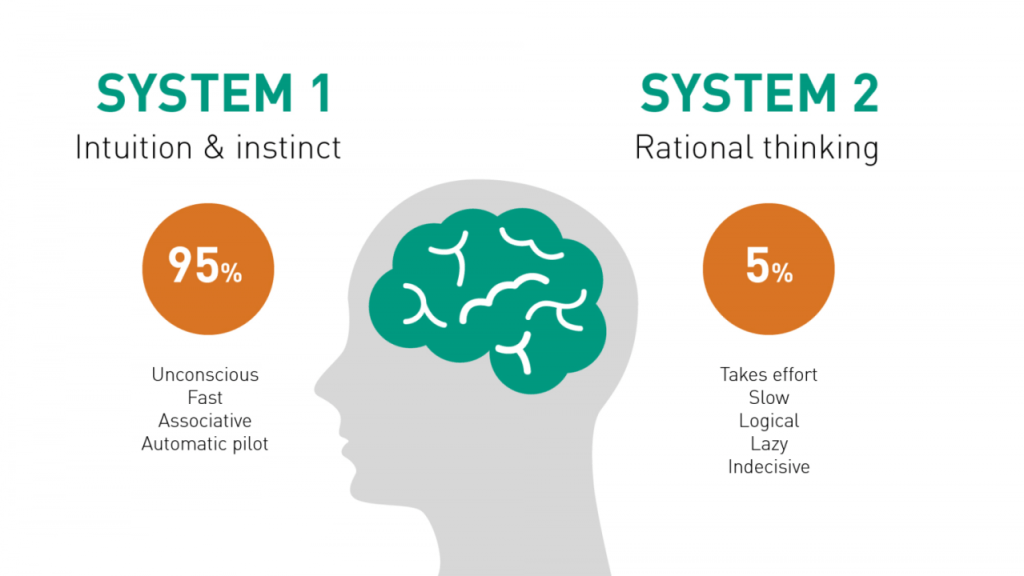
1/8 System 1 and System 2 Thinking

Making students (and staff) aware that humans spend most of their time on autopilot is vital. If you haven’t come across system 1 and system 2 thinking then look into it. It has so many implications for the classroom.

A typical question used to highlight the issues with system 1 thinking is the bat and ball question:

The first time people see this question it is almost impossible to think the answer is not $1.00. A quick bit of maths however shows you that it can’t be the case. What’s happened there? Well, your system 1 brain has chosen the most intuitive answer without doing much thinking about it. System 1 thinking is quiet but susceptible. Forcing students out of this mode is vital to getting the best out of them.
What if I told you this next question is designed to trip you up? It is designed to be as deceptive as the first question:

I’d bet any money this question would have a higher success rate than the first. I also think this would happen regardless of the order the questions were presented. The important thing is that you were jolted out of system 1 thinking and switched to system 2. All by yourself. Imagine harnessing this with students!

2/8 The Peak-End Rule

In an episode, there seems to be two main moments that stick in people’s minds. The emotional peak (the most intense event during the episode) and the end of the it. If there was ever a reason to really think hard about how your lessons end this would be it. The rule states that how students feel about themselves in relation to your subject is going to be heavily influenced by how they feel at the end. If you are always ending your lesson with the hardest content, what effect might this have? Conversely, if the lesson ends purposefully, with praise being shared and an achievable question being asked, what effect might that have?
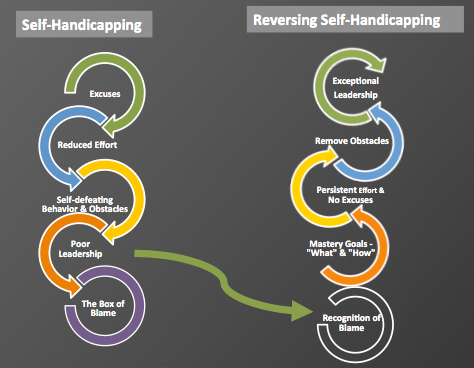
3/8 Self-Handicapping

For all sorts of reasons, humans do not always try their hardest. Deliberate self-sabotage to save face, reduce the effort needed, have excuses for poor performance… is a known phenomenon. Knowing this is the first step to tackling it. Talking about it with students and giving them the language to discuss and address unhelpful tendencies can sometimes be enough to change behaviour.

4/8 Recency Bias

Humans are much more influenced by what has happened more recently. A gambler who has won the last 3 rounds but lost the previous 10 is much more likely to believe they’re doing well than someone who won the first 3 and lost the next 10.

This could have a lot of implications in the classroom but one I think that could be particularly useful is in thinking about how to affect change on a class that you think you’ve lost. Knowing that the last few lessons are going to influence their perceptions on the class much more than anything that’s happened previously should give hope to it never being too late to turn things around.

5/8 Short-Term over Long-Term

Humans are much more concerned with short-term benefits than they are with long-term ones. Students may well want to do well in their exams, they may also know exactly how to revise, putting these two together when their exams are a long way away is not a given though. Creating short-term rewards where you can to encourage motivation may not only be sensible, it may be necessary.

6/8 We Want to Fit In

The desire to fit in can overrule the desire to do what you think is right in the moment. Knowing that if poor behaviour gets the spotlight in the classroom than it may encourage more to join in rather than the desired effect teachers are often hoping for which is to detour it.

7/8 Anchoring Effect

If you want something to be appealing, have something to compare it to where it looks favourable. The typical example of this is popcorn prices at the cinema. They are all ridiculous but buying a large for £5.80 suddenly seems attractive is a medium costs £5.40. Imagine a cold dark afternoon where you want students to complete 20-mins of work independently. Why not give them the choice between that and 30-mins wort of work independently. All of a sudden that 20-min task makes them feel like winners.

8/8 Availability Heuristics

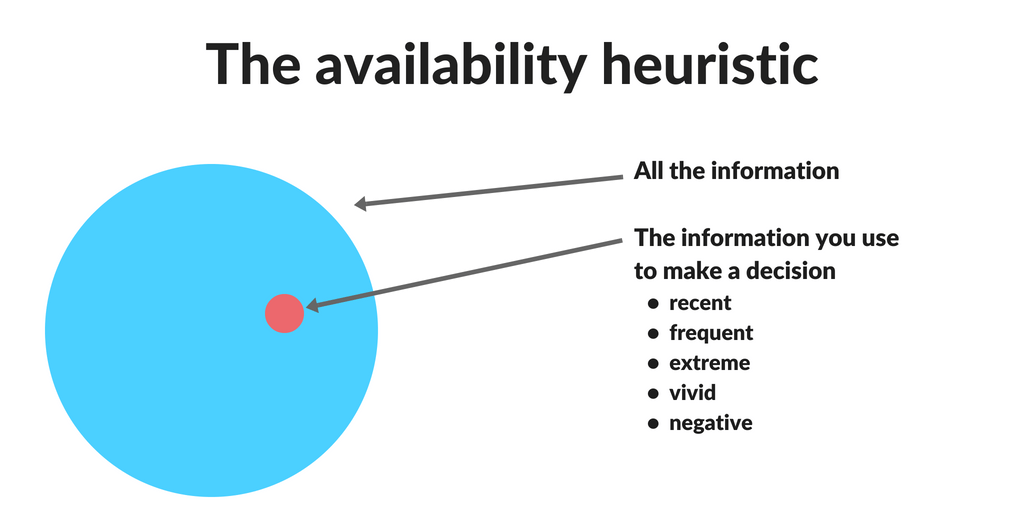
Humans, it turns out, are really bad at making decisions. If we start to combine ideas like system 1 and system 2 thinking and recency bias you get the begins of ideas like availability heuristics. The notion that we tend to only make decisions based on immediately available information rather than all the known information. Front loading expectations and consequences may then help shift behaviour patterns to be more desirable. Moving to a more proactive rather than reactive behaviour management style can help stop issues before they even begin.

Summary

I hope that at least some of the 8 ideas above resonate with people’s classroom experiences. I think that there is an untapped goldmine of research that is waiting to be applied to the classroom and I can’t wait to explore these ideas further in the future. Cognitive science is incredible for making sure an engaged individual is learning well, behavioural economics may be necessary to ensure that engagement is there in the first place.

I’m always interested in what people make of this so please feel free to comment with thoughts, questions or incomplete musings. Follow this or my Twitter account Teach_Solutions for similar content in the future.

Go-To Guides

What could a booklet that contains all the pedagogical subject knowledge one might need for a topic look like?

When I first starting teaching, I was given little else to aid my planning than a list of objectives from the National Curriculum and a number of weeks with which to cover the content. It’s safe to say that this was not enough to adequately prepare my students. Since then, I’ve been struggling to know the best way to prepare new teachers for all the things they need when approaching something for the first time. In an attempt to address this, the Go-To Guide was born.

Introducing the Go-To Guide

Inspired by the wonderful Pav Aujla (a Trust Lead for Science) who had produced booklets to share knowledge across multiple schools of what needed to be taught and when under the name of a Go-To Guide I thought I would give it a go for maths.

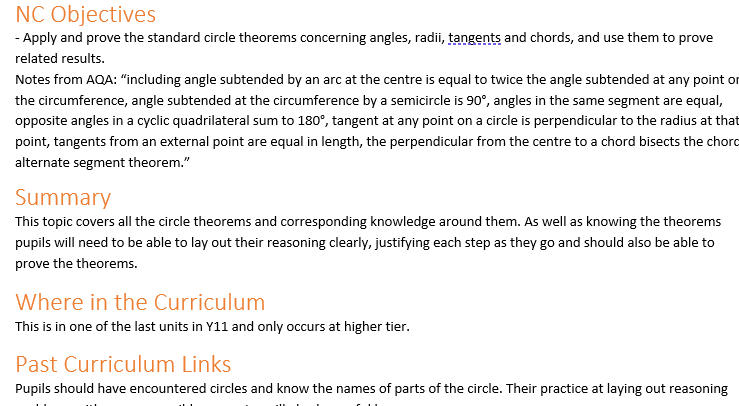
There are so many more things beyond just a list of objectives taken directly from the National Curriculum that are needed to prepare someone to teach content well to a group of students. These guides are not lessons but sit in the void between the curriculum and lesson delivery that sometimes does not get nearly as much attention as it deserves.

I will talk through one of the guides in detail here (the one for circle theorems), explain each section and show you what it contains. At the end I will include links to other completed examples and a blank template that contains notes on how to produce one from scratch.

Overview 1/7

Despite my earlier grievance, the guides do start by outlining the content from the curriculum that is going to be covered. It then translates this into actual English and makes any relevant links to past and future content both and any other relevant subject areas.

Topic Familiarisation 2/7

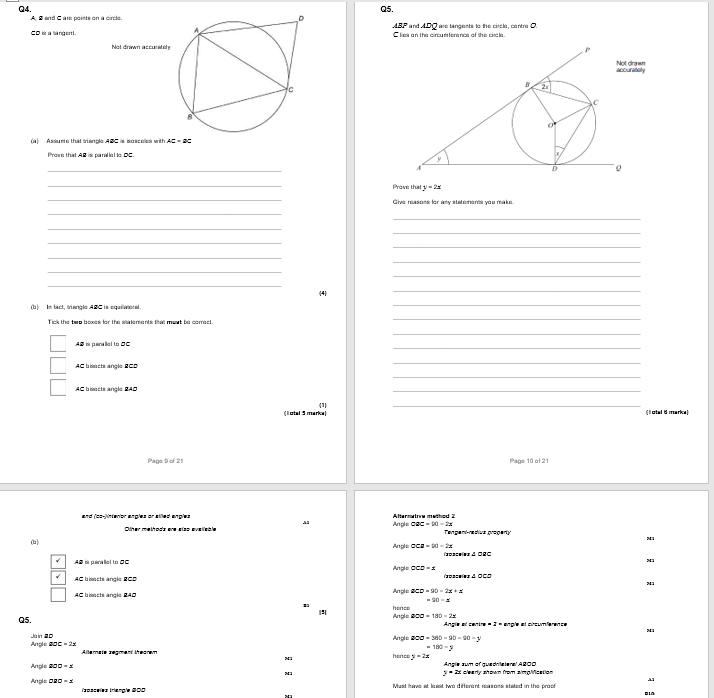
Teachers are expected to complete the Topic Familiarisation section themselves (there will be about 5-7 questions). There are some guiding questions here as well for teachers to consider whilst they go through these. Questions like:

It then moves on to a section called “Topic Familiarisation”. This is designed to showcase some of the weird and wonderful ways that this content is assessed. It contains questions, mark scheme and any examiners notes. It should help direct the teaching to cover more than just a surface level understanding the topic. The caveat here is that teachers need to be aware that they do not teach the topic to ensure students can answer just these questions but rather questions of this type having never seen these before.

– What might my students struggle with?

– What gaps are there in my subject knowledge?

– What do I want a model answer to look like?

– How do I know what to do for each question? What are the clues?

Possible Models and Tips 3/7

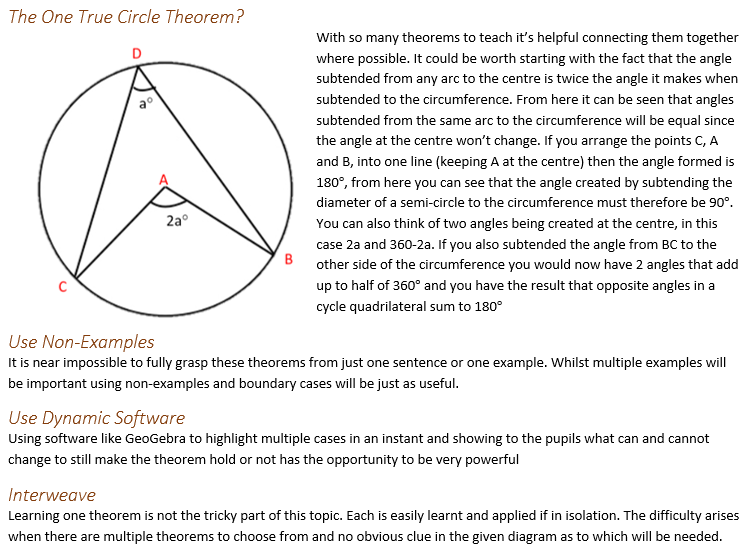
By this point teachers should have a good idea of what needs teaching, i.e. their subject knowledge should be secure. This section is designed to upskill relevant pedagogical subject knowledge. Approaches to teaching, common misconceptions, and general tips are shared unique to this topic.

Key Words 4/7

This is a space for relevant tier 2 and 3 vocabulary to live and be defined. One of the biggest misconceptions I think teachers have here is the sheer quantity of words that people think are tier 3 (maths specific) but are actually tier 2 (in common usage in other domains). To this end, not only are they two put into distinct sections but other uses of the word are defined so that teachers can make explicit links to other times and places students may have encountered these words.

Topic History and Hinterland 5/7

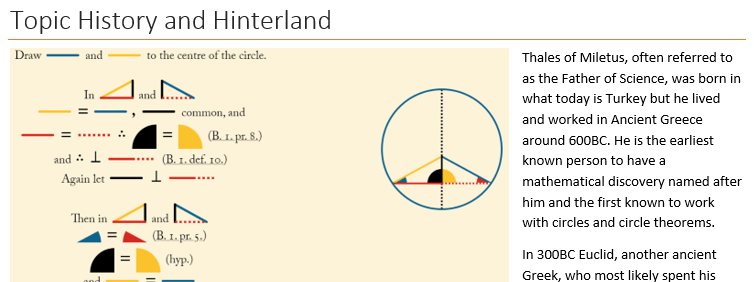
This is a chance for all those rich stories that are sometimes hidden in mathematics to come to life. This section contains relevant stories that have contributed to this part of the curriculum. Where possible, this will help expose both teachers and students to the diverse and global endeavour that mathematics has been and help shine a light all the fantastic people and civilisations that have contributed to the subject we know today.

Possible Learning Sequence 6/7

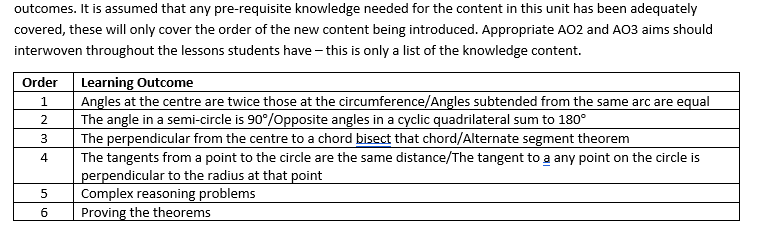
This suggests a possible sequencing of how this content could be taught. Each section is not a lesson as this will need to vary from class to class, but there is an attempt to sequence it logically in a way that will be conducive to learning.

Resources 7/7

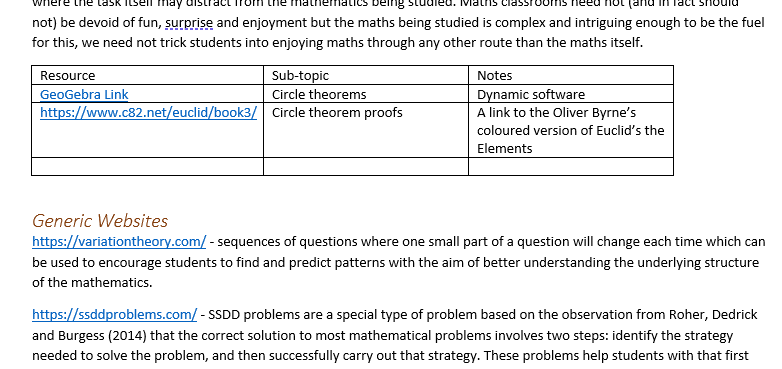
This last section contains a generic list to some tried and tested websites and a brief description of what they are (think Corbett, Geogebra, Nrich, Craig Barton’s websites…) but also contain specific resources that could be useful for this topic.

What Next?

The construction of these is currently an ongoing process. Some that have been made by myself are here and most are 90% complete. As a Trust we are trying to get full curriculum coverage and are prioritising those areas that either offer the most challenge from a subject knowledge point of view (circle theorems, advanced trigonometry…) or those that offer a particular challenge from a pedagogical subject knowledge stance (negative numbers, fractions…):

Template

Here is a blank template with written guidance for each section should you wish to make your own (feel free to delete all the branding surrounding it)

I hope some of this is useful to either yourself or colleagues. If it is, please feel free to share these around.

I’m always interested in what people make of this so please feel free to comment with thoughts, questions or incomplete musings. Follow this or my Twitter account Teach_Solutions for similar content in the future.

Dance Like Nobody’s Watching

Should we be teaching with the mindset that no one is listening?

I have found teaching to be so multi-faceted that it is hard for one training session or new idea to have a sizeable impact on my pedagogy. Instead, improvement for me has been the outcome of many different skills being slowly developed over time. Every now and then though, something happens which fundamentally changes my approach to teaching. This piece is about the biggest shift that has happened in my teaching recently, and the thinking that got me there.

The Big Idea

Teach like no one is listening. By that, I mean that no matter how clear I believe my explanation to be, how absolute I believe students’ focus on me is, how accurately I believe I am threading the needle between content that is too challenging and content that is too easy, I assume that not a single student has either understood or even listened to my explanation.

This is not about lowering expectations. I still want all the above things: clear explanations, a calm learning environment, well-pitched content. I just don’t take any of them as being any guarantee that anyone has learned anything. The mantra of “hope for the best, plan for the worst” is useful here and trust me, it changes everything.

This can be a hard shift to believe even needs to happen for many reasons. It is possible to hone both the clarity of your explanations and behaviour management strategies to the point that this seems redundant and almost defeatist. You could have taught something in the past that landed really well. You may be teaching to a room full of people with complete attention aimed at you, a room of 30 students seemingly hanging off your every word. Unfortunately, none of these are guarantees that anyone is learning anything and, if not addressed, you risk students picking up misconceptions, having gaps in knowledge, being confused and generally not learning as well as they could be.

Something interesting happened over lockdown. As classrooms moved from looking like this:

to this:

All of a sudden it became clear I had no idea what was being understood by students. A quick upskilling in how to use polls on Teams and whiteboard.fi fixed this. Back in the classroom though, despite all those smiling, seemingly attentive faces aimed at my teaching, I realised I had just as much guarantee of what was going on in their heads as when they were just dots on a screen. Something needed to change.

The Consequences

Check everything from everyone. It’s as simple as that really. After any period of modelling, getting students to attempt it, bit my bit, and show me, as a class, that they can do it before working independently is vital.

There has been a lot of talk of mini whiteboards recently but I think that talk misses the point. Mini whiteboards are just a tool. When teaching remotely to a someone without a camera, mini whiteboards are useless. What is important, is having the means, somehow, to check everyone’s understanding of everything. It just so happens that a cheap piece of plastic and a whiteboard pen are an invaluable tool when trying to achieve this in a classroom.

As soon as someone finds another way to more simply, quickly and accurately assess the understanding of an entire class all at once then I’ll use that instead. Until then, mini whiteboards are indispensable in acheiving my aim here.

The same applies to checking instructions about how to engage with a task as well. What conditions students should be working in? What classifies as success today? How long have they got? What should they do if they are stuck? All these things need checking or, that information needs storing somewhere permanent like on a sheet or on the board.

The assumption that nothing I have said has been listened to has improved my practice so much. There is no longer anywhere to hide, little chance of starting a task without comprehending the content, and no excuse for not following the behaviour routines expected.

If phases of the lesson don’t include multiple checks of all the key components needed for success from every student in the room then, under this new mantra, I’m assuming something is going to go wrong.

It involves removing ego from the equation. Assuming that, no matter how engaging or how clear I think I may be, I cannot assume that what I am saying is understood or, in truth, that all 30 students even particularly care what I’m talking about on any given day. I think it is essential in delivering a great education for all students that even those who are struggling to engage on any given day still have to do as much work as everyone else.

Mark Twain said “Dance like no one is watching.” I say “Teach like no one is listening”.

I’m always interested in what people make of this so please feel free to comment with thoughts, questions or incomplete musings. Follow this or my Twitter account Teach_Solutions for similar content in the future.

Are you thinking what I’m thinking?

How can we all be sure we’re talking about the same thing unless we’ve seen it?

Have you ever read a book and then when the film comes out things aren’t quite how you imagined them to be? What if the same happens in education?

It feels entirely possible to either metaphorically or literally drown in the amount of literature that is being released (this blog included) giving advice about how to do things well or better in education.

Nothing wrong with any of that. It’s great. The availability to access other people’s thoughts and ideas has never been easier. This has lead to incredible conversations, fueled further blogs, podcasts, articles, books which has then fueled more blogs, podcasts, articles and books, which has then… and hopefully somewhere along the line the experience pupils receive has been improved as well.

Although the profession now seems to be talking the same language (cognitive load, explicit instruction, SLANT, be seen looking, I do/We do/You do…), are we certain that means the same to all of us? Much like we can never be sure if two people see colours the same, can we ever be sure we mean the same thing when we use these terms? I suspect, unfortunately, not. At least not without tearing yourself away from just the words and getting yourself into a school and actually seeing it in action!

I felt relatively well read around all this but nothing could prepare me for what it was like working at King Solomon Academy. All of a sudden, I wasn’t reading or listening to thoughts about great practice, I was seeing it and living it.

I saw silent corridors be purposeful (everyone has their doors open all the time and break times don’t happen all at the same time so any noise in the corridor was going to disturb others lessons), family dining be truly commutity focused, lessons be distraction free, warm-strict be applied consistently, explicit instruction in action, think pair share working like a well-oiled machine. It raised the bar for me of what a school is able to acheive.

Having seen what is possible feeds into everything else I do. It raises expectations, gives me no reason to say something “isn’t possible” and, I hope, helps me push the people I work with to be even greater versions of themselves.

If it’s been a while since you’ve visited another school then try to change that. People’s doors seem more open than ever. From the wonderful programme Steplab are running to the general kindness of people that open their doors to others. Visiting a school has never been easier. The availability of data these days should mean you can also pick a school that suits your catchment and gets great outcomes.

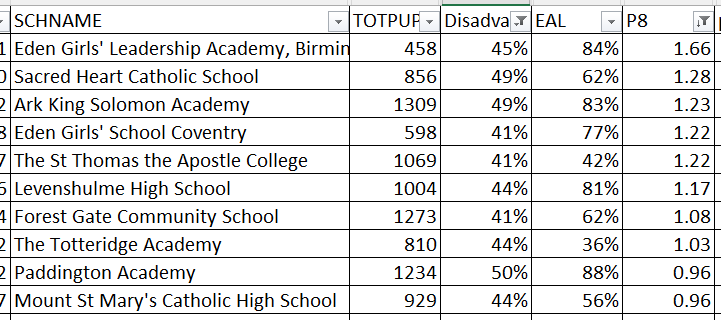
Here is a table, for example, of top progress scores for Secondary schools from 2022 who have more than 40% disadvantaged cohort. Many of these schools welcome visitors and you can be pretty sure you’ll learn something new if you visit.

Next time you are thinking about reading one more book, why not try asking for a day to visit somewhere great instead? Any sensible headteacher will be aware of the power that this CPD can have and the experience may just help reframe everything you thought was possible.

I’m always interested in what people make of this so please feel free to comment with thoughts, questions or incomplete musings. Follow this or my Twitter account Teach_Solutions for similar content in the future.

Hollywood has an Education Problem

I know what great teaching looks like, so how come movies can still make me feel so guilty?

These days, poor classroom practice is often blamed on outdated CPD, unhelpful training programmes, and a focus on gimmicky approaches. I feel like I now have a pretty good nose for bullshit nonsense and my pedagogical weather vane turns less in the direction of whatever new fad is popular and remains relatively steady these days. I consider myself well-informed and finally able to consistently teach lessons I’m happy with. Despite over a decade at this now there is still one source of information, one exposure to teaching practice, that makes me doubt myself more than any other, that makes my weather vane wobble… the silver screen.

Different sources have always inspired aspects of my career. These people have been colleagues, course leaders, children, folks on social media, friends, and family. Some have been inspirations from before I started and many influence me still.

There is one big group that I have missed out of that list. A group of people that have had perhaps a bigger impact on my visions of what me as a teacher should look like. Hollywood. The are the various screenwriters, actors, and directors that have presented to me a specific version of what a great teacher should be.

At the start of my career, this group had influenced me as much or even more than the other groups. The movies are awash with depictions of teachers. What’s more is that there is often the same distinctions made in every corner of Hollywood when defining the characteristics that make up “good” and “bad” teachers.

Western media seems to broadly have agreed what it takes to make a teacher fantastic. The issue is that this seems to be at best incomplete, and at worst totally at odds to what experience and research tells me works in practice.

In the good corner you have the John Keatings (Dead Poet’s Society), Miss Honeys (Matilda), Professor Lupins (Harry Potter), Erin Gruwells (Freedom Writers) and Dewey Finns (School of Rock) of the world. Each of their films has a nemesis, a villain, their antithesis sitting across from them in the bad corner. The Miss Trunchbulls, Professor Snapes, various heads of departments with chips on their shoulders… whoever that person is who insists the main teacher sticks rigorously to the syllabus and the school rules. Not only do these antagonists do things which make us actively dislike them personally, the portrayal as them as teachers also leaves us the with the impression that their practice is as evil as they are.

At its most basic, the dichotomy of The Pedagogically Good vs The Pedagogically Evil looks like this:

Good TeachersBad Teachers
Relationship focusedContent focused
CaringStrict
Goes off-curriculumSticks to the curriculum
Invests time after schoolNot seen after the bell
Rebels against school rulesSticks to school rules
Leads on a cult of personalitySystem-led

This blog is not saying that the content from the “good” column is actually bad, simply that it is not enough to create the sort of change that is often portrayed in these shows by itself. Without a healthy dose of both columns I do not think students receive a great education or that teachers can have a sustainable life. I’m not suggesting we send students to The Chokey or recite monotonically from a textbook every day but a more nuanced approach to teaching is needed than is often shown on the big screen.

Last week I watched the film Another Round. It follows four teachers who decide to be constantly half-cut to see what effect there is on their personal and professional lives. The film portrays the transition from sober to tipsy as one which positively impacts their teaching practice. These two versions of themselves (bad when sober and good when half-cut) follow the descriptors above. This is represented initially by them leading from the front and going through the same routines every lesson to, after a few drinks, trying novel things, having students sing in the dark with their eyes closed, comparing the students’ own drinking habits with those of Churchill to increase engagement, sitting in students’ seats while pupils lead from the front and, ultimately, inspiring their students to perform at a high level and graduate happy.

The tropes from this movie were nothing new, what struck me was the power that the film had to make me feel inadequate. At a stage in my career where I am fairly confident these “engaging” strategies (although useful and powerful at times) are nowhere near enough, in and of themselves, to get students to outshine the expectations the system places on them. I should not be doubting myself because of this film, yet I find I am. (Chances are you haven’t seen this film but rumours of an English language version with Di Caprio taken the lead role are swirling, so strap yourself in for some pangs of guilt on the horizon but please, please, hold your ground!).

All these films depicting teachers of academic subjects seem to disproportionately focus on novelty and relationships and leave me feeling like I’m the Trunchball in a world of Miss Honeys. I know that my work in the past has yielded great results and that students have felt cherished and cared for along the way yet, it only takes one film and I’m almost ready to insist my next lesson will be outside and that me and my students must rebel against any and all rules. Down with the system!

I found the urge to resist this when I first starting teaching, I’m afraid to say, impossible. I didn’t quite go full Hollywood, I didn’t have the nerve to rip up a textbook in front of students whilst they stood on their desks calling me Captain all the while forming a rock band to revolt against the principal, but at times, I wasn’t far off.

Is there a solution?

I know that a lot of what makes great teaching may not look great on screen and that the majority of the intended audience aren’t experienced teachers and so simplified version of teaching are needed to get the point across but it is possible to do it another way.

I can think of two examples that really resonate with my experience of what it takes to overcome the odds to achieve great results. Two occasions where knowledge-rich environments are combined with clear rules, where the adult carefully balances the needs of explicitly modelling content with forming those all-important relationships in a safe and predictable environment.

The first, and I mean this quite sincerely, is Arnold Schwarzenegger in Kindergarten Cop. If that isn’t a great example of how clear routines, positive reinforcement and leading from the front can set the scene for a great learning environment I don’t know what is. From the initial chaos that feels all too familiar to the eventual creation of a safe and productive learning environment through clarity and leadership, it feels like a genuine classroom and a genuine, albeit condensed, journey a developing teacher would go on. I can’t think of a better example highlighting the need for routines when working with children whilst also showing the ability to care and nurture a class at the same time. I also can’t think of a better representation of what it can be like teaching a class for the first time.

The second is the pair from Ted Lasso, the show’s namesake and Coach Beard. Two Americans in a “fish out of water story” coaching a football team in the UK. Whilst Ted, who knows nothing about football (“Heck, you could fill two internets with what I don’t know about football.”) goes about getting the culture right, Coach Beard is a font of knowledge about the sport. In tandem, they get the team training hard and believing in themselves. Neither of those two men, without the other, would lead to those players being the best versions of themselves on the football pitch. The combination of knowledge, training, and hard work mixed with coaching self-belief, respect, and determination is a rare combo. Although it takes two of them to do the job, combined they represent the qualities any great teacher needs.

Perhaps representations of sports leaders get this balance right more often than not, but why people think academia doesn’t require the same level of hard, sometimes monotonous, work to improve oneself as physical sport baffles me.

Here’s hoping that in the future, we can either have better representations of what it really takes to be a great teacher on screen or, at the very least, that I have the confidence to not feel so bad about myself when I see an inspiring yet flawed teacher presented to me on the TV.

I’m always interested in what people make of this so please feel free to comment with thoughts, questions or incomplete musings. Follow this or my Twitter account Teach_Solutions for similar content in the future. Also, check out the rest of this site, there’s some good stuff knocking about the place.